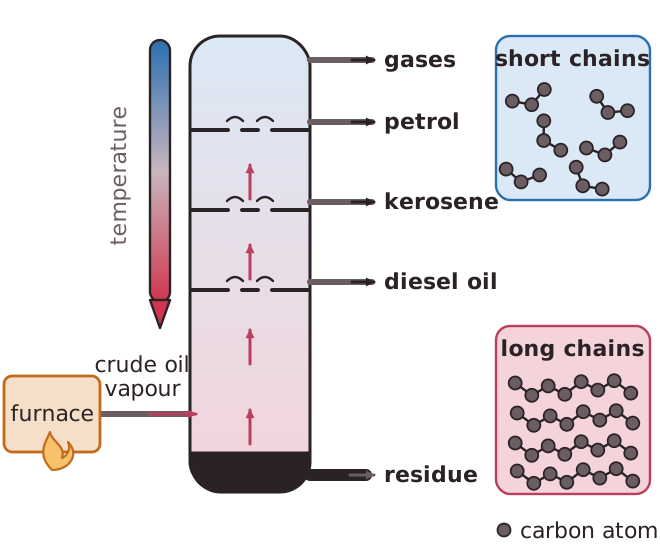
Fractional distillation works because the hydrocarbons in crude oil have different boiling points, and the boiling point depends on the size of the molecule. Hydrocarbons are made of small covalent molecules. Between these molecules are weak forces called intermolecular forces. When a hydrocarbon boils, the intermolecular forces are overcome so the molecules can separate. The strong covalent bonds inside each molecule do not break.
The longer the carbon chain, the larger the molecule, and the stronger the intermolecular forces between the molecules. More energy is needed to overcome stronger forces, so larger molecules have higher boiling points. Small molecules have weak intermolecular forces and low boiling points, so they stay as vapour until they reach the cooler top of the column.
In the column, large molecules condense low down where it is hotter, because their boiling point is high. Small molecules rise further before they condense. So the molecules are separated by size, with small molecules at the top and large molecules at the bottom. The fractions with larger molecules are also more viscous and harder to ignite.