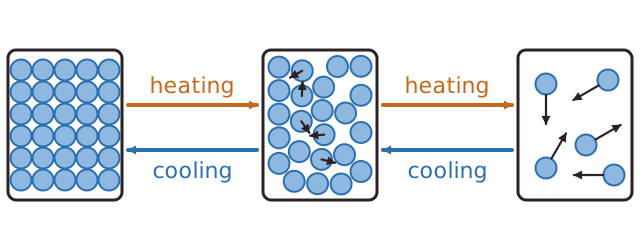
The three states of matter are solid, liquid and gas. A solid changes to a liquid at the melting point, and the reverse change, liquid to solid, is freezing at the same temperature. A liquid changes to a gas at the boiling point, and the reverse change, gas to liquid, is condensing. You can predict the state of a substance from its data: below the melting point it is a solid, between the melting point and the boiling point it is a liquid, and above the boiling point it is a gas.
In the simple particle model, particles are drawn as small solid spheres. Changing state needs energy to overcome the forces between the particles. The amount of energy needed depends on how strong those forces are, and that depends on the type of bonding and the structure of the substance. The stronger the forces between the particles, the more energy is needed, and so the higher the melting point and boiling point.
Atoms themselves do not have the bulk properties of a material. A single atom of copper is not shiny or solid, and a single atom does not melt. Properties such as melting point belong to a large collection of particles.
Higher tier only: the simple model has limits. In the model there are no forces between the spheres, all particles are shown as spheres, and the spheres are solid.