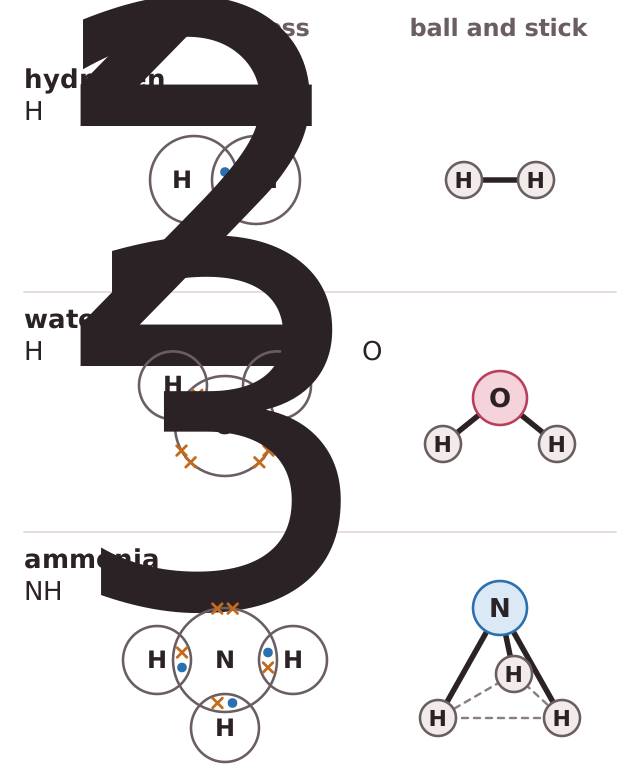
When atoms share pairs of electrons, they form covalent bonds. These bonds between atoms are strong. Each shared pair is one bond, and in a diagram a single bond is drawn as a line. In a methane molecule, the carbon atom shares four pairs of electrons, one with each hydrogen atom. In a water molecule, the oxygen atom shares two pairs, one with each hydrogen atom.
Many covalently bonded substances consist of small molecules, such as hydrogen, chlorine, oxygen, nitrogen, hydrogen chloride, water, ammonia and methane. You can recognise a small molecule from its formula, because it contains only a few non-metal atoms, for example H2O or NH3. Some covalent substances have very large molecules, such as polymers. A polymer is drawn as its repeating unit in brackets, with n to show that n is a large number.
Other covalent substances are giant covalent structures, such as diamond and silicon dioxide. They are huge networks of atoms joined by strong covalent bonds, with no separate molecules.
Models of covalent substances have limitations. A dot and cross diagram shows which atom each electron comes from but not the shape of the molecule. A ball and stick diagram shows the shape, but the sticks are not real. A three-dimensional diagram of a giant structure shows only a small part of it. You can deduce a molecular formula by counting the atoms of each element in a model, so one carbon atom joined to four hydrogen atoms gives CH4.