Skip to content

Ionic Bonding

Ionic bonding is the electrostatic attraction between oppositely charged ions.

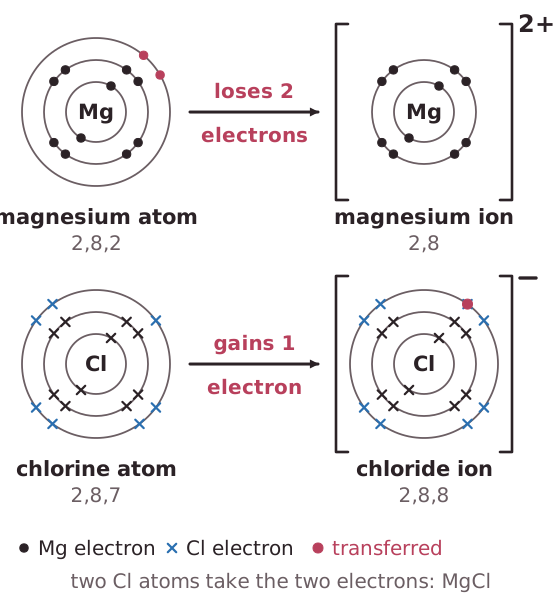
Outer shell electrons from a metal atom are transferred to the outer shell of a non-metal atom. The metal atom becomes a positive ion (cation) and the non-metal atom becomes a negative ion (anion).
The ions formed have the same configuration as a noble gas and are therefore electronically stable.
Read the text

Read the text and highlight anything you think is important. When you go on, the text is hidden and you answer from memory.

Specification: OCR Chemistry A (H032), AS-level, 2.2.2 Bonding and structure. Topic: Electrons and Bonding.

Key terms in this lesson

Ion
A positively or negatively charged atom or group of atoms, formed by the loss or gain of electrons.
Cation
A positively charged ion, formed when an atom loses one or more electrons.
Anion
A negatively charged ion, formed when an atom gains one or more electrons.
Electron shell
A main energy level occupied by electrons, given a principal quantum number n, with n = 1 closest to and lowest in energy relative to the nucleus.

More in Electrons and Bonding

All 7 lessons in Electrons and Bonding · All OCR AS-level Chemistry topics