 BRAINCAKE
Electron Structure
Electrons are arranged within shells around the nucleus. The shells are regarded as energy levels. Each energy level has a principal quantum number n = 1, 2, 3, 4, 5, 6, 7 with the shell n = 1 with the lowest energy and closest to the nucleus.
Electrons have properties of both waves and particles. The maximum number of electrons in a shell is given by 2n2. Each shell is subdivided into s, p, d or f sub-shells with slightly different energies. The sub-shells in the first four quantum shells are 1s, 2s, 2p, 3s, 3p, 3d, 4s, 4p, 4d, 4f.
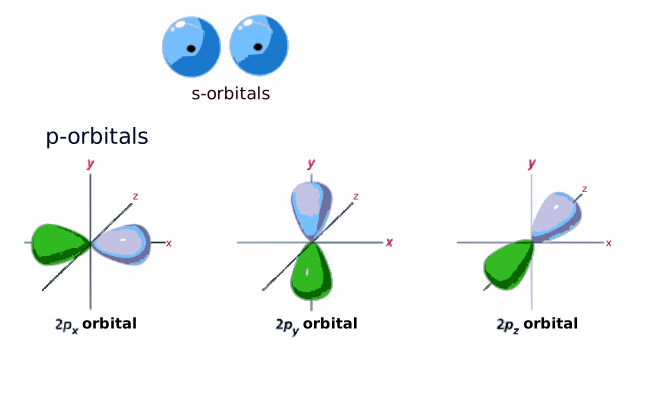
Sign in free to see the rest of this lesson, the R.E.C.I.P.E. recall steps and the quiz
BrainCake is free. Make an account in seconds and pick up where this page stops.
Key terms in this lesson
- Electron shell
- A main energy level occupied by electrons, given a principal quantum number n, with n = 1 closest to and lowest in energy relative to the nucleus.
- Sub-shell
- A subdivision of a main energy level (s, p, d or f) made up of orbitals of similar energy.
- Atomic orbital
- A region in space where there is a high probability (90-95%) of finding an electron.
More in Electrons and Bonding
- Filling of Orbitals and Electron Pairing
- Ionic Bonding
- Structure and Properties of Ionic Compounds
- Covalent Bonding
- Single, Double and Triple Bonds
- Dative Covalent Bonds
All 7 lessons in Electrons and Bonding · All OCR AS-level Chemistry topics