IR spectroscopy can measure how much of a substance is present, as well as identify it. The amount of radiation absorbed at a characteristic wavenumber increases with the concentration of the absorbing compound, so a calibrated instrument can convert an absorbance reading into a concentration.Breathalysers
Modern breathalysers used by the police to obtain evidence pass infrared radiation through a sample of a driver's breath. Ethanol absorbs at wavenumbers characteristic of its C-H and C-O bonds. The instrument measures how much radiation is absorbed and a computer converts this into the concentration of ethanol in the breath, which is compared with the legal limit. The O-H absorption is not used, because water vapour in breath also contains O-H bonds and would interfere. The readings are accurate enough to be used as evidence in court.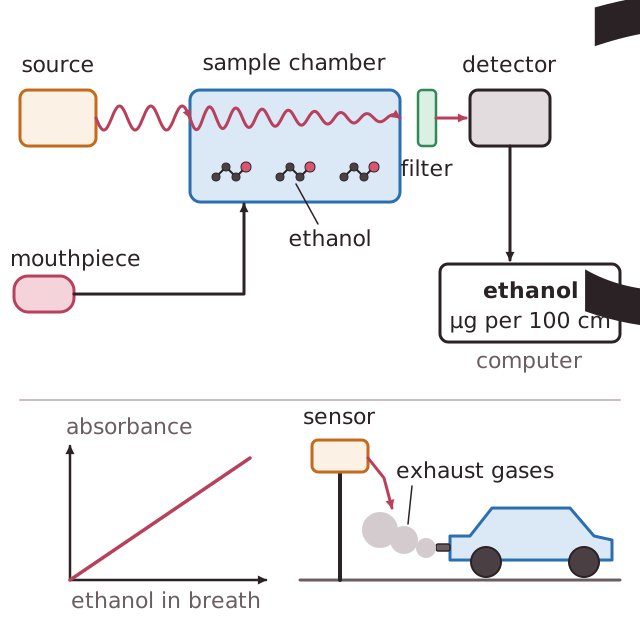 Pollution monitoring
IR sensors monitor gases that cause air pollution, such as carbon monoxide (CO) and nitrogen monoxide (NO) from car engines. Each gas absorbs at its own characteristic wavenumber, so its concentration can be measured in exhaust gases and in the air at busy roadsides. This is used in vehicle emissions testing, in checking that catalytic converters are working, and in monitoring air quality in towns.Worked example: the legal limit for driving in England and Wales is 35 μg of ethanol per 100 cm3 of breath. A driver's reading is 49 μg per 100 cm3.49 ÷ 35 = 1.4 The reading is 1.4 times the legal limit.
Modern breathalysers used by the police to obtain evidence pass infrared radiation through a sample of a driver's breath. Ethanol absorbs at wavenumbers characteristic of its C-H and C-O bonds. The instrument measures how much radiation is absorbed and a computer converts this into the concentration of ethanol in the breath, which is compared with the legal limit. The O-H absorption is not used, because water vapour in breath also contains O-H bonds and would interfere. The readings are accurate enough to be used as evidence in court.
Pollution monitoringIR sensors monitor gases that cause air pollution, such as carbon monoxide (CO) and nitrogen monoxide (NO) from car engines. Each gas absorbs at its own characteristic wavenumber, so its concentration can be measured in exhaust gases and in the air at busy roadsides. This is used in vehicle emissions testing, in checking that catalytic converters are working, and in monitoring air quality in towns.Worked example: the legal limit for driving in England and Wales is 35 μg of ethanol per 100 cm3 of breath. A driver's reading is 49 μg per 100 cm3.