To interpret an IR spectrum, look for a small number of key absorptions rather than trying to explain every trough.Method
1. Is there a strong, sharp C=O trough at 1630 to 1820 cm−1?
2. Is there a broad O-H trough? Alcohol O-H is at 3200 to 3600 cm−1; carboxylic acid O-H is very broad at 2500 to 3300 cm−1.
3. Is there a C-O trough at 1000 to 1300 cm−1?
4. Combine the evidence:
• alcohol: broad O-H and C-O, no C=O
• aldehyde or ketone: C=O, no O-H
• carboxylic acid: very broad O-H and C=O (and C-O)
• ester: C=O and C-O, no O-H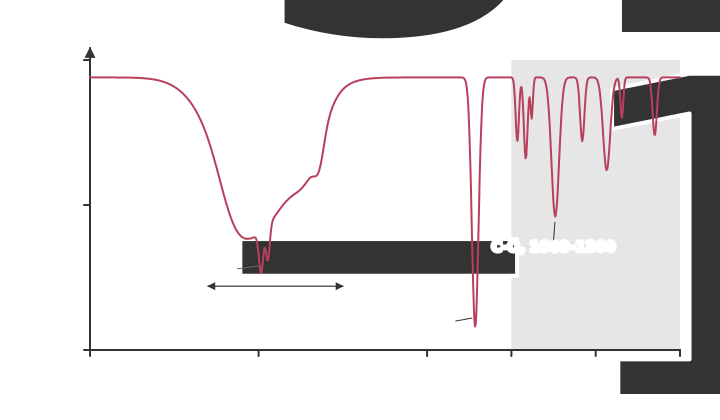
1. Is there a strong, sharp C=O trough at 1630 to 1820 cm−1?
2. Is there a broad O-H trough? Alcohol O-H is at 3200 to 3600 cm−1; carboxylic acid O-H is very broad at 2500 to 3300 cm−1.
3. Is there a C-O trough at 1000 to 1300 cm−1?
4. Combine the evidence:
• alcohol: broad O-H and C-O, no C=O
• aldehyde or ketone: C=O, no O-H
• carboxylic acid: very broad O-H and C=O (and C-O)
• ester: C=O and C-O, no O-H