Each type of bond absorbs in a characteristic range of wavenumbers. The ranges are given on the OCR Data Sheet, so you do not need to learn the numbers, but you must be able to use them.Key absorptions (cm−1)
• C-O: 1000 to 1300 (alcohols, esters, carboxylic acids)
• C=C: 1620 to 1680 (alkenes)
• C=O: 1630 to 1820 (aldehydes, ketones, carboxylic acids, esters)
• C≡N: 2220 to 2260 (nitriles)
• C-H: 2850 to 3100 (most organic compounds)
• O-H in carboxylic acids: 2500 to 3300, very broad
• N-H: 3300 to 3500 (amines, amides)
• O-H in alcohols and phenols: 3200 to 3600, broad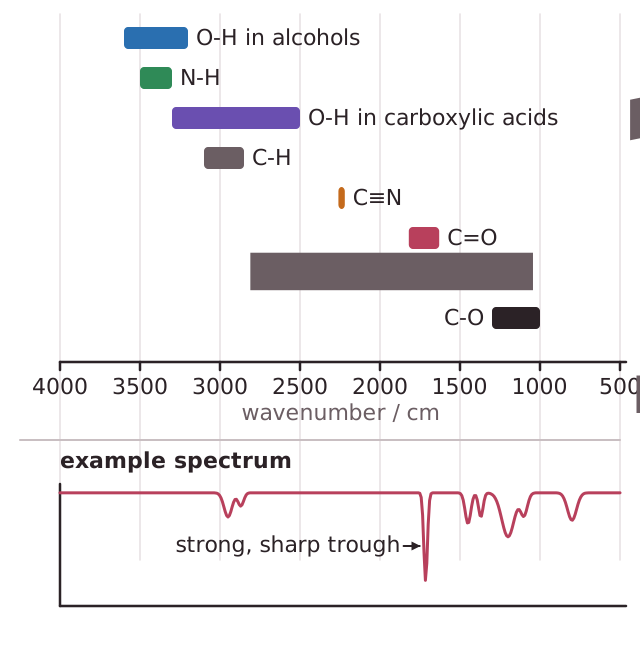 The shape of a trough helps as well as its position. O-H absorptions are broad because of hydrogen bonding between molecules; the O-H in a carboxylic acid is very broad and often overlaps the C-H absorptions. The C=O absorption is usually strong and sharp.Almost every organic compound has C-H bonds, so the C-H absorption at 2850 to 3100 cm−1 is rarely useful for identification. Focus on C=O, O-H, C-O, N-H and C≡N.Worked example: a compound shows a strong, sharp trough at 1715 cm−1 and no broad trough between 2500 and 3600 cm−1. 1715 lies within 1630 to 1820, so the compound contains C=O, and the lack of a broad trough shows there is no O-H group.
• C-O: 1000 to 1300 (alcohols, esters, carboxylic acids)
• C=C: 1620 to 1680 (alkenes)
• C=O: 1630 to 1820 (aldehydes, ketones, carboxylic acids, esters)
• C≡N: 2220 to 2260 (nitriles)
• C-H: 2850 to 3100 (most organic compounds)
• O-H in carboxylic acids: 2500 to 3300, very broad
• N-H: 3300 to 3500 (amines, amides)
• O-H in alcohols and phenols: 3200 to 3600, broad
The shape of a trough helps as well as its position. O-H absorptions are broad because of hydrogen bonding between molecules; the O-H in a carboxylic acid is very broad and often overlaps the C-H absorptions. The C=O absorption is usually strong and sharp.Almost every organic compound has C-H bonds, so the C-H absorption at 2850 to 3100 cm−1 is rarely useful for identification. Focus on C=O, O-H, C-O, N-H and C≡N.Worked example: a compound shows a strong, sharp trough at 1715 cm−1 and no broad trough between 2500 and 3600 cm−1. 1715 lies within 1630 to 1820, so the compound contains C=O, and the lack of a broad trough shows there is no O-H group.