Covalent bonds are not rigid. They behave like springs, constantly vibrating by stretching (the bond length changes) and bending (the bond angle changes). When a molecule absorbs infrared radiation, the energy makes its bonds vibrate more.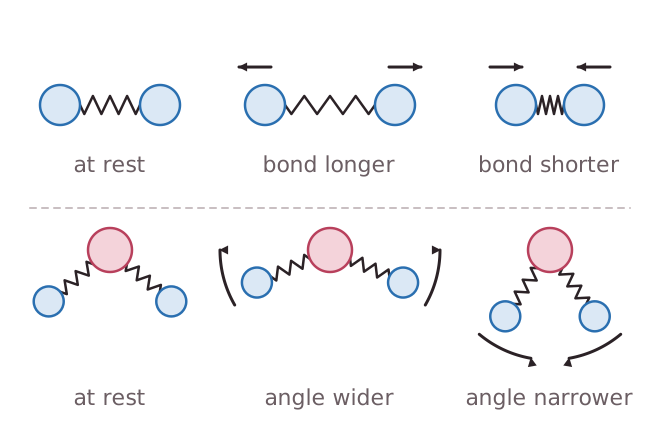 Each bond has a natural frequency of vibration. A bond absorbs IR radiation only when the frequency of the radiation matches this natural frequency. The frequency depends on:
• bond strength: stronger bonds vibrate at higher frequency, so they absorb at higher wavenumber.
• mass of the atoms: bonds to light atoms vibrate faster. Hydrogen is the lightest atom, so O-H, N-H and C-H bonds absorb at high wavenumbers (above 2500 cm−1).This is why each type of bond absorbs in its own characteristic range of wavenumbers, which is the basis of IR spectroscopy.IR and the greenhouse effect
The Earth's surface emits infrared radiation. Atmospheric gases containing C=O, O-H and C-H bonds absorb some of it, so their bonds vibrate more; the energy is then re-emitted in all directions, some back towards the Earth, warming the lower atmosphere. This links the main greenhouse gases to their bonds: carbon dioxide (C=O), water vapour (O-H) and methane (C-H). Nitrogen and oxygen, the main gases in air, absorb very little IR, so they are not greenhouse gases.Example: C=O absorbs at about 1700 cm−1 and C-O at about 1100 cm−1. Both bonds join the same two atoms, so the difference comes from bond strength: the double bond is stronger, so it vibrates at a higher frequency.
Each bond has a natural frequency of vibration. A bond absorbs IR radiation only when the frequency of the radiation matches this natural frequency. The frequency depends on:• bond strength: stronger bonds vibrate at higher frequency, so they absorb at higher wavenumber.
• mass of the atoms: bonds to light atoms vibrate faster. Hydrogen is the lightest atom, so O-H, N-H and C-H bonds absorb at high wavenumbers (above 2500 cm−1).This is why each type of bond absorbs in its own characteristic range of wavenumbers, which is the basis of IR spectroscopy.IR and the greenhouse effect
The Earth's surface emits infrared radiation. Atmospheric gases containing C=O, O-H and C-H bonds absorb some of it, so their bonds vibrate more; the energy is then re-emitted in all directions, some back towards the Earth, warming the lower atmosphere. This links the main greenhouse gases to their bonds: carbon dioxide (C=O), water vapour (O-H) and methane (C-H). Nitrogen and oxygen, the main gases in air, absorb very little IR, so they are not greenhouse gases.Example: C=O absorbs at about 1700 cm−1 and C-O at about 1100 cm−1. Both bonds join the same two atoms, so the difference comes from bond strength: the double bond is stronger, so it vibrates at a higher frequency.