 BRAINCAKE
Effect of Catalysts
A catalyst is a substance that increases the rate of a reaction without being used up. It is chemically unchanged at the end of the reaction.
A catalyst works by providing an alternative reaction pathway with a lower activation energy. It often does this by forming an intermediate with a reactant, or by holding reactant molecules on its surface where bonds are weakened.
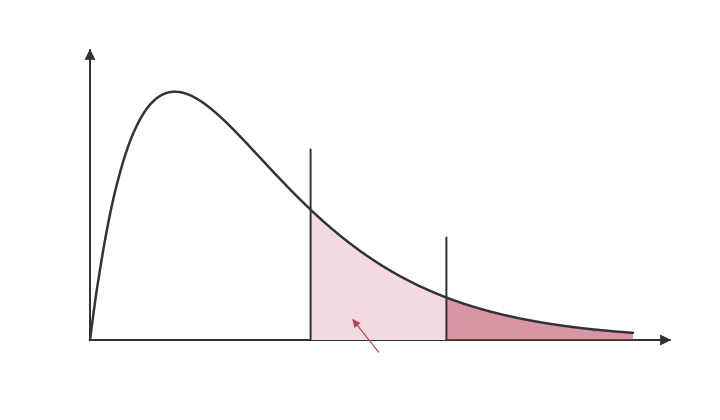
The effect is shown on a Maxwell-Boltzmann distribution. The curve itself does not change, because the temperature is the same. But the catalysed activation energy, Ecat, is to the left of the uncatalysed Ea, so a much larger area lies to the right of it.
Sign in free to see the rest of this lesson, the R.E.C.I.P.E. recall steps and the quiz
BrainCake is free. Make an account in seconds and pick up where this page stops.
Key terms in this lesson
- activation energy
- The minimum energy that colliding particles must have for a reaction to occur.
More in Reaction Rates
- Steric Hindrance
- Effect of Concentration
- Effect of Pressure
- Effect of Surface Area
- Maxwell-Boltzmann Distribution Curve
- Effect of Temperature
- Collisions in Solution
- Catalysts in Industry
All 12 lessons in Reaction Rates · All Edexcel AS-level Chemistry topics