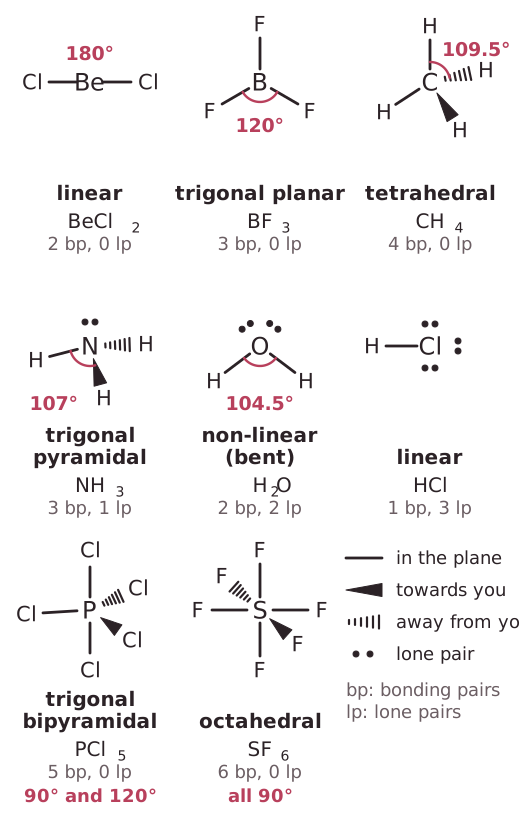
Electron pairs arrange themselves around a central atom so that the repulsion between them is a minimum. This is known as the electron pair repulsion theory.
Shapes depend on the number of
lone pairs and bonding pairs.
| bonding pairs | lone pairs | shape | example(s) |
| 2 | 0 | linear | BeCl2 |
| 3 | 0 | trigonal planar | BF3, AlCl3 |
| 4 | 0 | tetrahedral | CH4 |
| 5 | 0 | trigonal bipyramidal | PCl5 |
| 6 | 0 | octahedral | SF6 |
| 3 | 1 | trigonal pyramidal | NH3 |
| 2 | 2 | non-linear | H2O |
| 1 | 3 | linear | HCl |
CH
4 with 4 bonding pairs is tetrahedral with a bond angle of 109.5°. Ammonia has a lone pair and 3 bonding pairs and is trigonal pyramidal. The lone pair pushes the bonds closer together giving a bond angle of 107°. Water has 2 lone pairs so the bond angle is pushed further to 104.5° and the shape is non-linear or bent.