A dative covalent bond is formed when an empty orbital of one atom overlaps with an orbital containing a non-bonding pair (lone pair) of electrons of another atom.It is a shared pair of electrons where both electrons are supplied by only one of the atoms involved in the bond.
The shared pair of electrons is supplied by a lone pair on one atom.
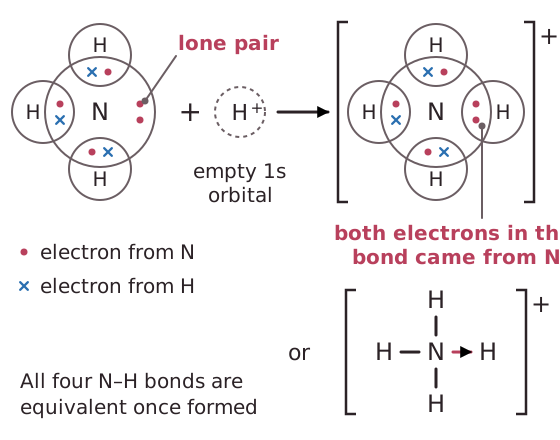
The ammonium ion is formed when the lone pair on the nitrogen atom in NH3 is donated to a hydrogen ion H+ with an empty orbital.
Although shown with an arrow → all four bonds are equivalent and it is not possible to tell the difference.
In boron trifluoride and aluminium trichloride, the central atom has only six electrons in its outer shell, so it has an empty orbital. AlCl3 forms dimers by bonding together. A lone pair on a chlorine atom of one molecule forms a dative covalent bond with the aluminium atom of the other molecule. In the gas phase AlCl3 exists as Al2Cl6.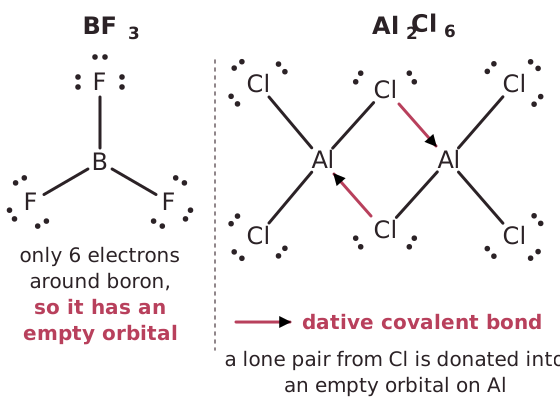
A dative covalent bond or a co-ordinate bond is a covalent bond in which the shared pair of electrons has been supplied by only one of the bonding atoms.
The shared pair of electrons is supplied by a lone pair on one atom.
The ammonium ion is formed when the lone pair on the nitrogen atom in NH3 is donated to a hydrogen ion H+ with an empty orbital.
Although shown with an arrow → all four bonds are equivalent and it is not possible to tell the difference.
In boron trifluoride and aluminium trichloride, the central atom has only six electrons in its outer shell, so it has an empty orbital. AlCl3 forms dimers by bonding together. A lone pair on a chlorine atom of one molecule forms a dative covalent bond with the aluminium atom of the other molecule. In the gas phase AlCl3 exists as Al2Cl6.