The drift of bonded electrons towards the more electronegative element results in a dipole.The overall dipole depends on the shape of the molecule. Individual dipoles can either cancel each other out or reinforce each other.If there is an overall dipole, the molecule is said to be polar. The polarity of a dipole is measured by its dipole moment, which is the size of the partial charge (δ) multiplied by the distance of separation between the charges.
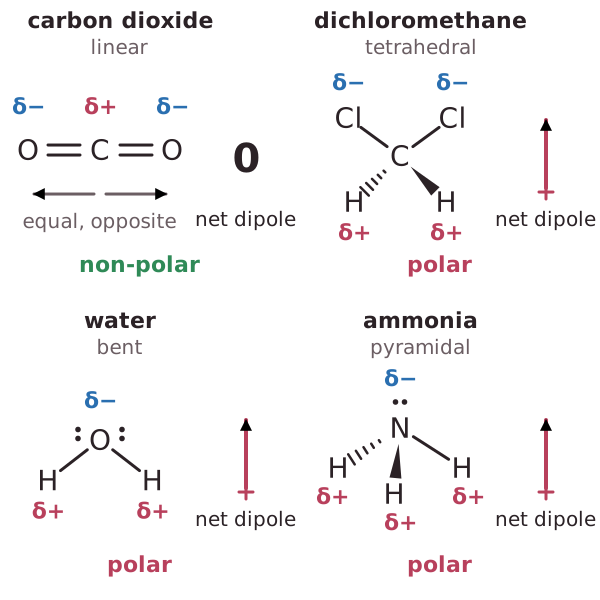
Shape and Polarity
Read the text
Read the text and highlight anything you think is important. When you go on, the text is hidden and you answer from memory.
Specification: Edexcel Chemistry (8CH0), AS-level, Topic 2A: Bonding. Topic: Discrete Molecules.
More in Discrete Molecules
- Electron Pair Repulsion Theory
- The Shapes of Molecules
- Molecules with Multiple Bonds
- Bond Angles
- Polyatomic Ions
- London Forces
- Permanent Dipoles
- Hydrogen Bonds
All 25 lessons in Discrete Molecules · All Edexcel AS-level Chemistry topics