The Electron Pair Repulsion Theory states that electron pairs arrange themselves around a central atom so that the repulsion between them is a minimum.Lone pair-lone pair repulsion > lone pair-bond pair repulsion > bond pair-bond pair repulsionShapes depend on the number of lone pairs and bonding pairs. CH4 with 4 bonding pairs is tetrahedral with a bond angle of 109.5°. Ammonia has a lone pair and 3 bonding pairs and is trigonal pyramidal. The lone pair pushes the bonds closer together giving a bond angle of 107°. Water has 2 lone pairs so the bond angle is pushed further to 104.5° and the shape is non-linear or bent.
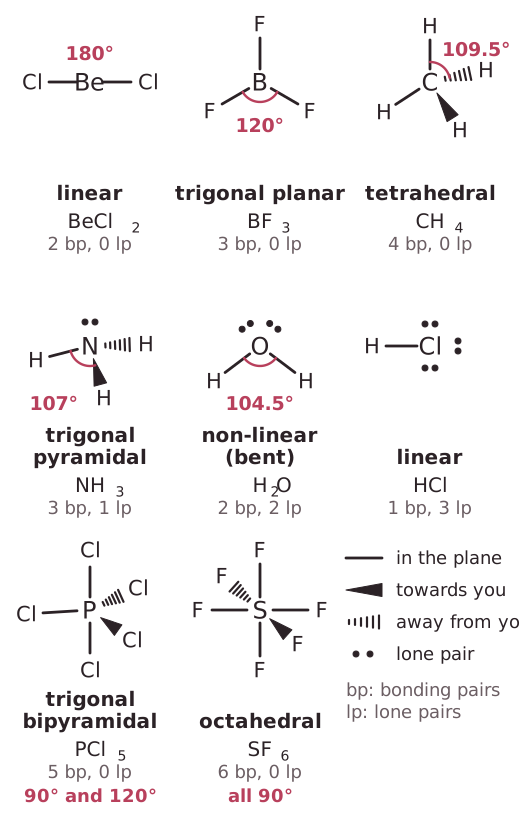
Electron Pair Repulsion Theory
Read the text
Read the text and highlight anything you think is important. When you go on, the text is hidden and you answer from memory.
Specification: Edexcel Chemistry (8CH0), AS-level, Topic 2A: Bonding. Topic: Discrete Molecules.
Key terms in this lesson
- lone pair
- A pair of outer shell electrons on an atom that is not involved in bonding.
More in Discrete Molecules
- Simple Molecules
- Expanded Octet Rule
- Displayed Formulae
- Dative Covalent Bonds
- The Shapes of Molecules
- Molecules with Multiple Bonds
- Bond Angles
- Shape and Polarity
All 25 lessons in Discrete Molecules · All Edexcel AS-level Chemistry topics