A nucleophile is an electron pair donor. The name means 'nucleus loving': nucleophiles are attracted to positive centres, such as a carbon atom carrying a partial positive charge (δ+) or a positive ion.To donate a pair of electrons, a nucleophile must have a lone pair. It uses this lone pair to form a new covalent (dative) bond to the positive centre. Nucleophiles are either negative ions or neutral molecules with a lone pair. Common examples:• hydroxide ion, :OH−
• cyanide ion, :CN−
• halide ions such as :Br−
• ammonia, :NH3 (lone pair on nitrogen)
• water, H2O: (lone pairs on oxygen)A negative ion is usually a stronger nucleophile than a similar neutral molecule, because its full negative charge is more strongly attracted to a positive centre. For example, OH− reacts with halogenoalkanes much faster than H2O does.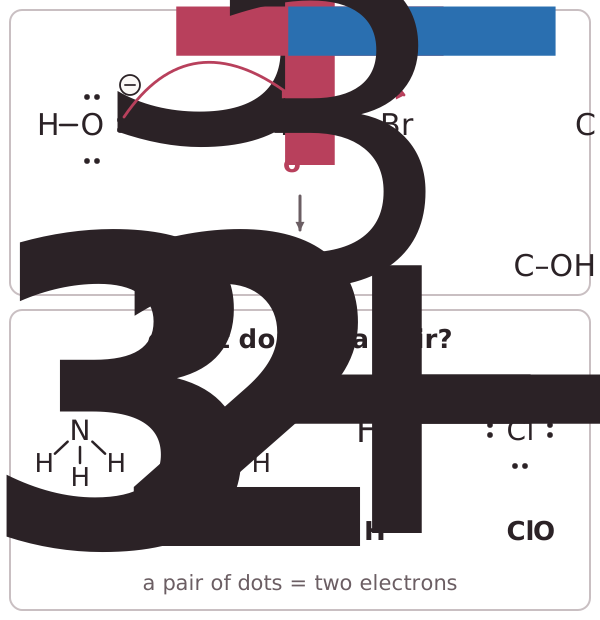 Electrophile or nucleophile? They are opposites: an electrophile accepts an electron pair, a nucleophile donates one. H+ has no electrons to donate and is an electrophile; NH3 has a lone pair and is a nucleophile.Where you meet nucleophiles: in electrophilic addition to alkenes, the second step is a nucleophile (for example a bromide ion) attacking the positive carbocation. In halogenoalkane chemistry, nucleophiles attack the δ+ carbon bonded to the halogen and replace it.
• cyanide ion, :CN−
• halide ions such as :Br−
• ammonia, :NH3 (lone pair on nitrogen)
• water, H2O: (lone pairs on oxygen)A negative ion is usually a stronger nucleophile than a similar neutral molecule, because its full negative charge is more strongly attracted to a positive centre. For example, OH− reacts with halogenoalkanes much faster than H2O does.
Electrophile or nucleophile? They are opposites: an electrophile accepts an electron pair, a nucleophile donates one. H+ has no electrons to donate and is an electrophile; NH3 has a lone pair and is a nucleophile.Where you meet nucleophiles: in electrophilic addition to alkenes, the second step is a nucleophile (for example a bromide ion) attacking the positive carbocation. In halogenoalkane chemistry, nucleophiles attack the δ+ carbon bonded to the halogen and replace it.