Alkenes react with electrophiles by electrophilic addition. The mechanism is shown with curly arrows: each curly arrow shows the movement of a pair of electrons. It starts at a bond or a lone pair and points to where the electrons go.The mechanism for ethene and bromine happens in two steps.Step 1: as Br2 approaches the C=C bond, the π electrons repel the electrons in the Br-Br bond, inducing a dipole. The bromine nearer the double bond becomes slightly positive (δ+). A curly arrow goes from the C=C bond to the δ+ bromine, and a second curly arrow goes from the Br-Br bond onto the δ− bromine. The Br-Br bond breaks by heterolytic fission: both electrons go to one bromine atom, forming a bromide ion, Br−. The other bromine is now bonded to one carbon, and the other carbon has lost a share of electrons and carries a positive charge. This ion is a carbocation intermediate.
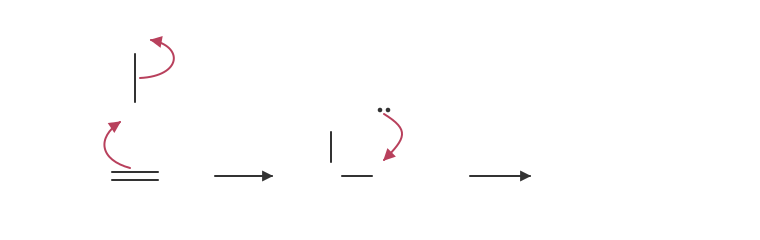
Step 2: the bromide ion uses a lone pair to attack the positive carbon (a curly arrow from the lone pair on Br− to C+). A new C-Br bond forms and the product is 1,2-dibromoethane.Evidence for the carbocation: if ethene is bubbled into bromine water containing sodium chloride, 1-bromo-2-chloroethane forms as well as 1,2-dibromoethane. The chloride ions must have attacked a positive intermediate, which shows that the two bromine atoms do not add at the same time.
Electrophilic Addition Mechanism
Read the text
Read the text and highlight anything you think is important. When you go on, the text is hidden and you answer from memory.
Specification: Edexcel Chemistry (8CH0), AS-level, Topic 6C: Alkenes. Topic: Alkenes.
More in Alkenes
- Hydration
- Addition of Hydrogen Halides
- Electrophile
- Nucleophile
- Electrophilic Addition of Hydrogen Halides
- Unsymmetrical Molecules
- Addition Polymerisation
- Identifying the Monomer
All 19 lessons in Alkenes · All Edexcel AS-level Chemistry topics