 BRAINCAKE
Electrophilic Addition of Hydrogen Halides
Hydrogen halides add to alkenes by the same electrophilic addition mechanism as bromine, with one difference in how the electrophile arises.
The H-Br bond is already polar: bromine is more electronegative than hydrogen, so the molecule has a permanent dipole, Hδ+-Brδ−. The δ+ hydrogen atom is the electrophile. (With Br2, the dipole has to be induced by the alkene.)
Mechanism for ethene + HBr
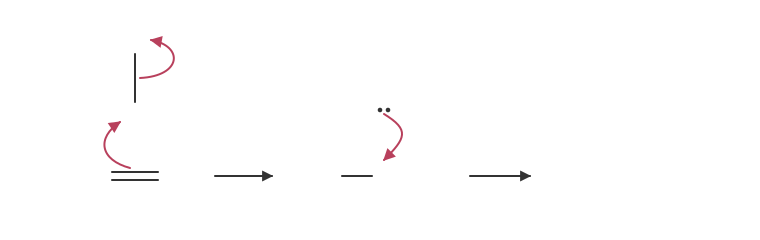
Sign in free to see the rest of this lesson, the R.E.C.I.P.E. recall steps and the quiz
BrainCake is free. Make an account in seconds and pick up where this page stops.
Key terms in this lesson
- heterolytic fission
- The breaking of a covalent bond in which one atom takes both electrons, forming a positive and a negative ion.
- carbocation
- A positively charged carbon ion formed when a carbon atom loses a share in a bonding pair of electrons.
More in Alkenes
- Addition of Hydrogen Halides
- Electrophile
- Nucleophile
- Electrophilic Addition Mechanism
- Unsymmetrical Molecules
- Addition Polymerisation
- Identifying the Monomer
- Identifying the Repeating Group
All 19 lessons in Alkenes · All Edexcel AS-level Chemistry topics