Hydration is the addition of water across a C=C double bond. The product is an alcohol. Industrially, ethanol is made by the hydration of ethene with steam:CH2=CH2(g) + H2O(g) ⇌ CH3CH2OH(g) Conditions: steam, a phosphoric acid catalyst (H3PO4 on a solid silica support), a temperature of about 300°C and a pressure of about 60-70 atm.The reaction is reversible and exothermic. A lower temperature would give a higher equilibrium yield, but the rate would be too slow, so 300°C is a compromise. High pressure favours the side with fewer gas molecules (the ethanol side) and increases the rate, but very high pressures would make the ethene polymerise and cost too much.Only about 5% of the ethene is converted on each pass through the reactor. The ethanol is condensed out and the unreacted ethene is recycled, so the overall conversion reaches about 95%.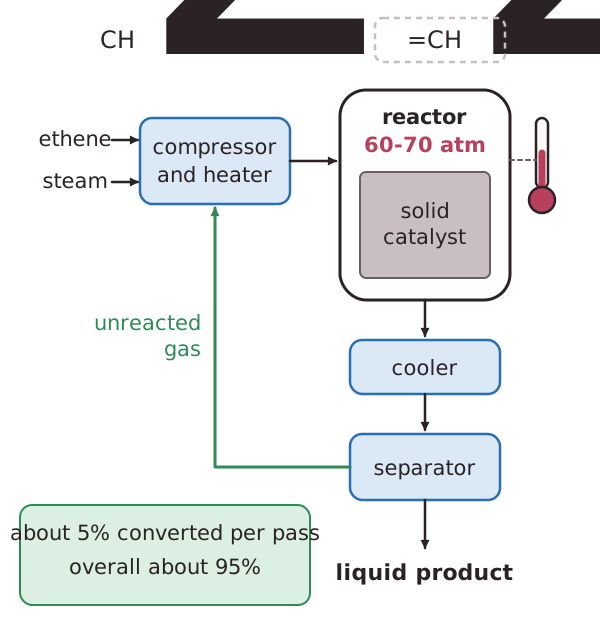 The process is continuous, fast and gives pure ethanol, but it uses ethene from crude oil, a non-renewable resource.A symmetrical alkene gives only one alcohol: for example, but-2-ene gives butan-2-ol. An unsymmetrical alkene such as propene can give two different alcohols, which is explained in a later lesson.