The repeat unit is the smallest part of a polymer chain that repeats over and over to build the whole chain. For an addition polymer made from a monomer with one C=C bond, the repeat unit contains two main-chain carbon atoms.From a monomer to the repeat unit:1. Draw the two carbon atoms of the C=C, joined by a single bond instead of the double bond.
2. Draw every other atom or group on these carbons as a side group, above or below the chain.
3. Draw an extension bond out from each carbon, to show the chain continues.
4. Put square brackets across the extension bonds and write n after the closing bracket.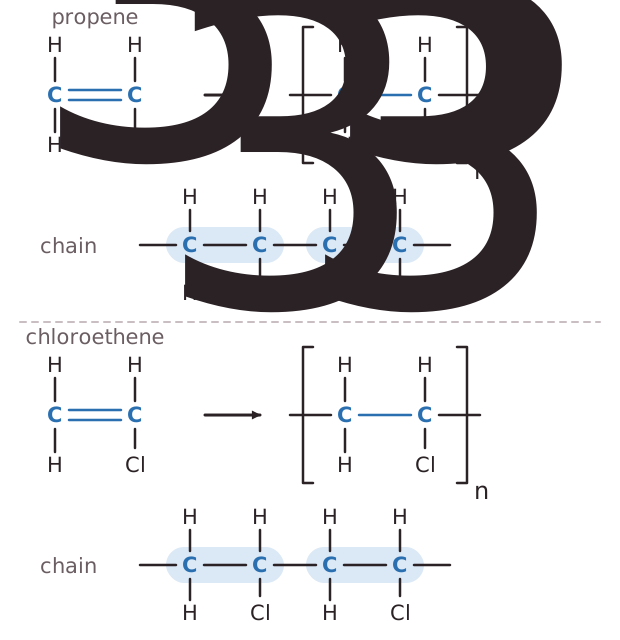 Example: propene, CH2=CHCH3, gives the repeat unit -[CH2-CH(CH3)]-. The methyl group is a side group; it is not part of the main chain.Other examples: ethene gives -[CH2-CH2]-, and 1,1-dichloroethene, CH2=CCl2, gives -[CH2-CCl2]-, where the second carbon carries two chlorine atoms.From a section of polymer: count along the main chain in pairs of carbons. A section with 8 main-chain carbons contains 4 repeat units. The side groups in each repeat unit must match exactly.Worked example: a section of poly(chloroethene) has 6 carbon atoms in the main chain. It contains 6 ÷ 2 = 3 repeat units, and each repeat unit has one Cl atom, so the section carries 3 chlorine atoms.Remember that a repeat unit is not the same as the monomer: it has no C=C bond and it has extension bonds.
2. Draw every other atom or group on these carbons as a side group, above or below the chain.
3. Draw an extension bond out from each carbon, to show the chain continues.
4. Put square brackets across the extension bonds and write n after the closing bracket.
Example: propene, CH2=CHCH3, gives the repeat unit -[CH2-CH(CH3)]-. The methyl group is a side group; it is not part of the main chain.Other examples: ethene gives -[CH2-CH2]-, and 1,1-dichloroethene, CH2=CCl2, gives -[CH2-CCl2]-, where the second carbon carries two chlorine atoms.From a section of polymer: count along the main chain in pairs of carbons. A section with 8 main-chain carbons contains 4 repeat units. The side groups in each repeat unit must match exactly.Worked example: a section of poly(chloroethene) has 6 carbon atoms in the main chain. It contains 6 ÷ 2 = 3 repeat units, and each repeat unit has one Cl atom, so the section carries 3 chlorine atoms.Remember that a repeat unit is not the same as the monomer: it has no C=C bond and it has extension bonds.