A pure substance has fixed physical properties. Measuring the melting temperature of a solid, or the boiling temperature of a liquid, and comparing it with the value in a data book is a simple test of purity.SolidsA pure solid melts at one sharp, fixed temperature (over a range of about 1 °C). Impurities lower the melting temperature and make the solid melt over a wider range.To measure it, a small amount of the dry, powdered solid is put into a capillary tube sealed at one end. The tube is placed in a melting temperature apparatus (an electrically heated block with a thermometer, or an oil bath). The sample is heated quickly at first, then slowly near the expected melting temperature, so that the thermometer reading keeps up with the temperature of the sample. The temperatures at which the solid starts and finishes melting are recorded.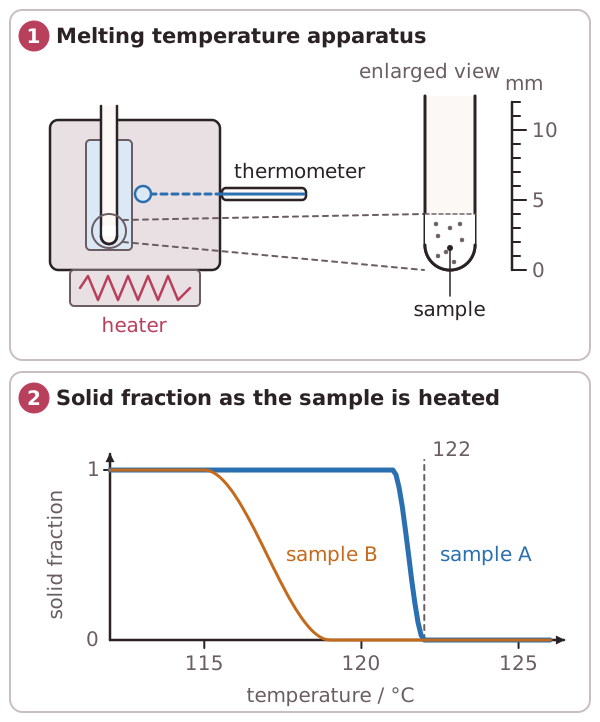 LiquidsA pure liquid boils at a fixed temperature. The boiling temperature is measured by distilling the liquid and reading the thermometer at the side arm, or with a boiling tube and thermometer. Impurities usually make the liquid boil over a range of temperatures, and non-volatile impurities raise the boiling temperature.ExampleBenzoic acid has a data book melting temperature of 122 °C. Sample A melts at 121 to 122 °C, so it is pure. Sample B melts at 115 to 119 °C: the low value and the wide range show it is impure. It could be purified further and tested again.