Simple distillation separates a volatile liquid from non-volatile substances, or from liquids whose boiling temperatures are very different. In organic preparations it is used to separate the crude product from the reaction mixture, for example to collect an aldehyde as it forms when a primary alcohol is oxidised.The mixture is heated in a round-bottomed flask containing a few anti-bumping granules, which give smooth boiling. The vapour rises into the still head, where the thermometer bulb is placed level with the side arm, so it measures the temperature of the vapour passing into the condenser. The vapour is cooled in a Liebig condenser. Cold water enters at the bottom and leaves at the top, so the water jacket stays full and cooling is efficient. The condensed liquid, the distillate, is collected in a receiver.
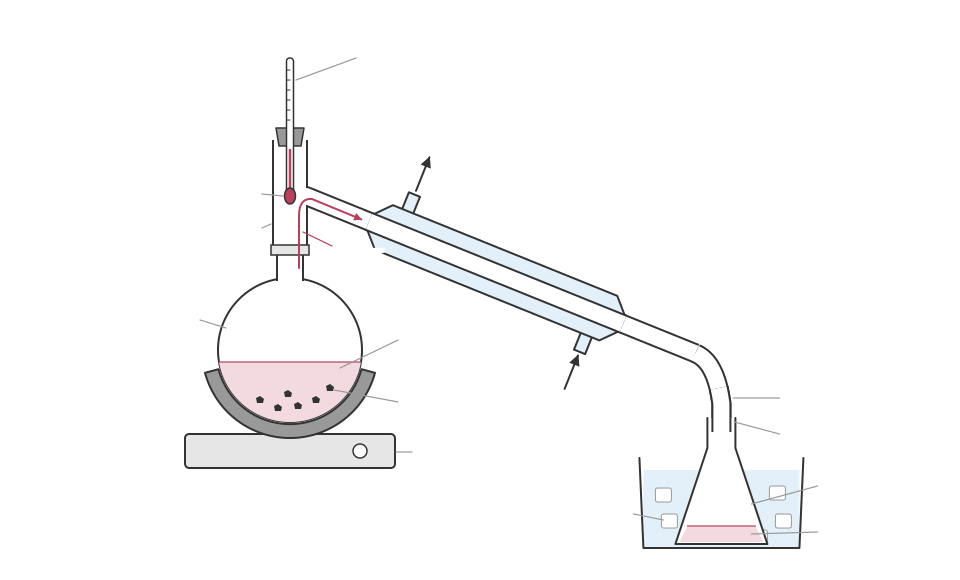
Good practice:• Heat with an electric heater or a water bath instead of a naked flame, because most organic liquids are flammable.• Never seal the apparatus. It must be open to the air at the receiver end, or pressure builds up.• Collect only the liquid that distils within a degree or two of the boiling temperature of the product you want.• Cool the receiver in ice if the product is very volatile.For example, ethanal boils at 21 °C and ethanol at 78 °C, so ethanal distils over first and ethanol stays in the flask.
Purification by Simple Distillation
Read the text
Read the text and highlight anything you think is important. When you go on, the text is hidden and you answer from memory.
Specification: Edexcel Chemistry (8CH0), AS-level, Topic 6E: Alcohols. Topic: Alcohols.
More in Alcohols
- Reactions of Alcohols
- Conversion to Halogenoalkanes
- Dehydration
- Oxidation Reactions of Alcohols
- Fractional Distillation
- Solvent Extraction
- Drying
- Test for Purity
All 16 lessons in Alcohols · All Edexcel AS-level Chemistry topics