Skip to content

Solvent Extraction

Solvent extraction uses two immiscible liquids (liquids that do not mix) to separate substances. It is carried out in a separating funnel (tap funnel). The two liquids form two layers, and the denser liquid forms the lower layer.
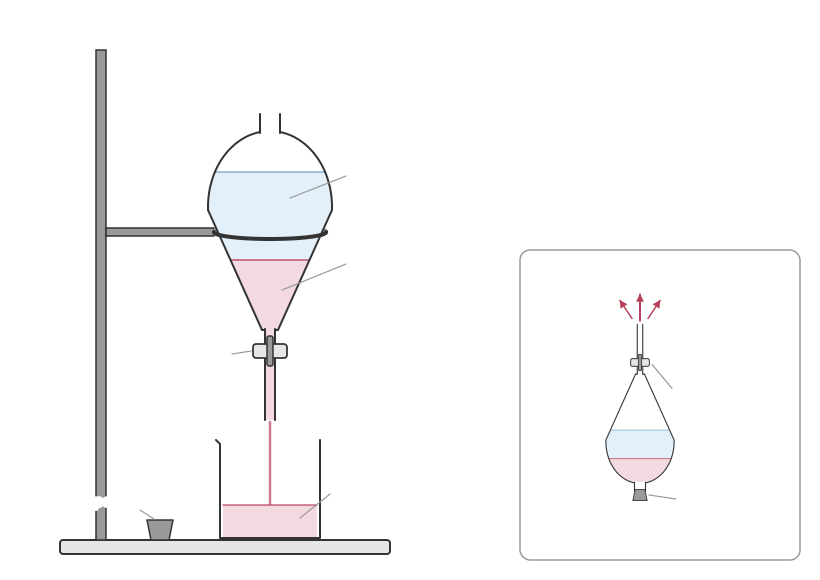
In organic preparations the crude product is often an organic liquid mixed with water and water-soluble impurities. The method is:• Pour the mixture into the separating funnel with the tap closed, add the washing liquid and put in the stopper.• Invert the funnel and shake it gently. Open the tap regularly (with the funnel upside down) to release pressure from vapour or gas.• Stand the funnel in a clamp, remove the stopper and let the layers settle.• Open the tap to run off the lower layer, then keep the layer that contains the product.Washing with water removes water-soluble impurities. Washing with sodium hydrogencarbonate solution removes acidic impurities, such as traces of acid from the reaction. The acid reacts to give carbon dioxide gas, so the funnel must be vented often.To decide which layer is which, compare densities, or add a few drops of water and see which layer gets bigger. For example, 1-bromobutane has a density of 1.27 g cm-3, so it forms the lower layer under water.Several extractions with small volumes of solvent remove more of a substance than one extraction with the same total volume. The organic layer is then dried before it is distilled.

Read the text

Read the text and highlight anything you think is important. When you go on, the text is hidden and you answer from memory.