Fractional distillation separates a mixture of miscible liquids whose boiling temperatures are close together. Simple distillation cannot do this well, because the vapour from such a mixture contains a lot of both liquids.A fractionating column is fitted between the flask and the still head. The column is packed with glass beads or rings, which give a large surface area. There is a temperature gradient up the column: it is hottest at the bottom and coolest at the top.
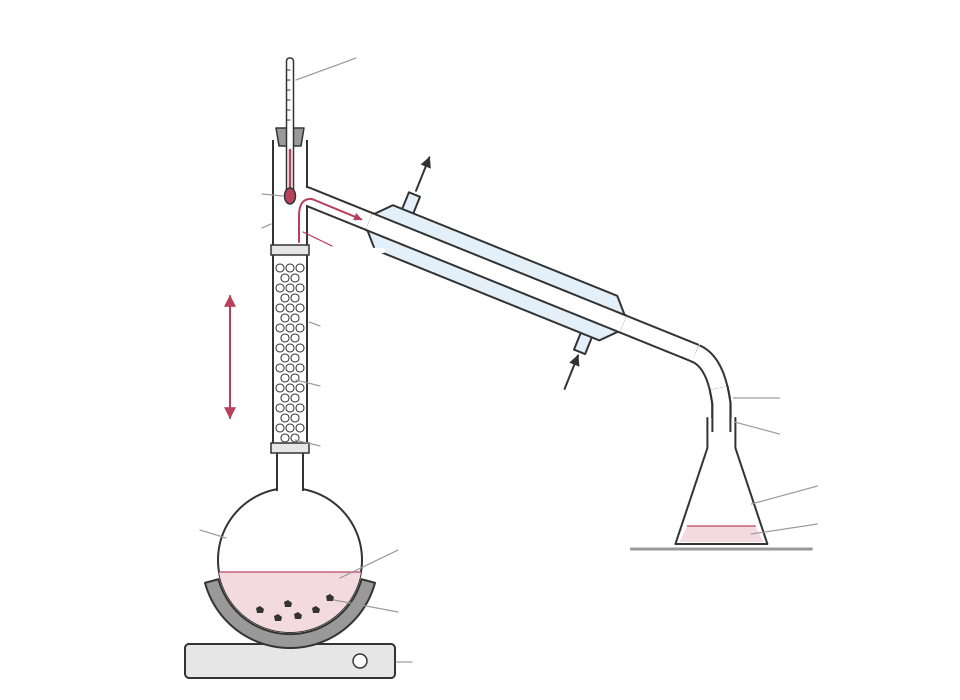
As the vapour rises, it condenses on the packing and is vaporised again many times. Each time, the vapour becomes richer in the component with the lower boiling temperature. By the time the vapour reaches the top of the column it is almost pure, so the most volatile liquid distils over first.The thermometer reading stays almost constant while one liquid distils. When the reading starts to rise, the receiver is changed to collect the next fraction. Heating slowly gives a better separation, because the vapour and liquid in the column have time to reach equilibrium.Example: a mixture of propan-2-ol (boiling temperature 82 °C) and propan-1-ol (97 °C). The first fraction, collected at about 82 °C, is mainly propan-2-ol. The temperature then rises and a second fraction, mainly propan-1-ol, is collected at about 97 °C.
Fractional Distillation
Read the text
Read the text and highlight anything you think is important. When you go on, the text is hidden and you answer from memory.
Specification: Edexcel Chemistry (8CH0), AS-level, Topic 6E: Alcohols. Topic: Alcohols.
More in Alcohols
- Conversion to Halogenoalkanes
- Dehydration
- Oxidation Reactions of Alcohols
- Purification by Simple Distillation
- Solvent Extraction
- Drying
- Test for Purity
- Exam Style Question - 1
All 16 lessons in Alcohols · All Edexcel AS-level Chemistry topics