Most metals have strong metallic bonds, high electrical conductivity in the solid and liquid states and high melting and boiling points.
Metals are good conductors because electrons are mobile charge carriers and they can move through the lattice.
Melting point depends on the strength of the metallic bonds. Group 1 metals have the weakest bonds because only one electron per metal ion is involved in the bonding and the positive ion has a charge of +1.
In contrast, magnesium is a much harder metal with the cation having a +2 charge and there being two delocalised electrons.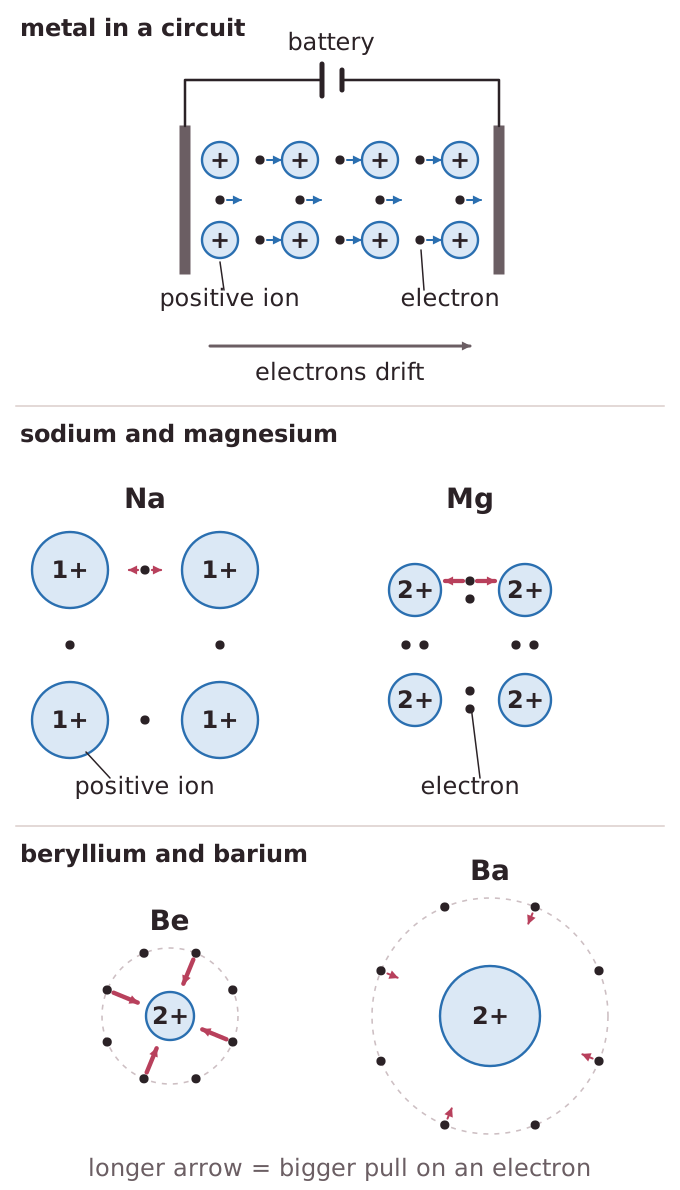 Metals do not dissolve.
Metals are good conductors because electrons are mobile charge carriers and they can move through the lattice.
Melting point depends on the strength of the metallic bonds. Group 1 metals have the weakest bonds because only one electron per metal ion is involved in the bonding and the positive ion has a charge of +1.
In contrast, magnesium is a much harder metal with the cation having a +2 charge and there being two delocalised electrons.
Metals do not dissolve.