In a non-polar bond, the bonded electron pair is shared equally between the two bonded atoms because either the atoms have the same or similar electronegativities or the atoms are the same.for instance in O2 or Cl2.In these cases the bond is a pure covalent bond.
Polar bonds are formed between atoms with different electronegativities. For example, hydrogen chloride gas is polar. There is a small partial positive charge δ+ on the hydrogen and a small partial negative charge δ- on the chlorine atom.The H-Cl bond is polarised. The separation of opposite charges is called a dipole.Water is a polar molecule with the hydrogens being δ+ and the oxygens being δ-. Because the molecule is bent, the dipoles do not oppose each other.Carbon dioxide O=C=O has two polar C=O bonds. However, the molecule is linear and the dipoles oppose each other and cancel each other out, so carbon dioxide is non-polar.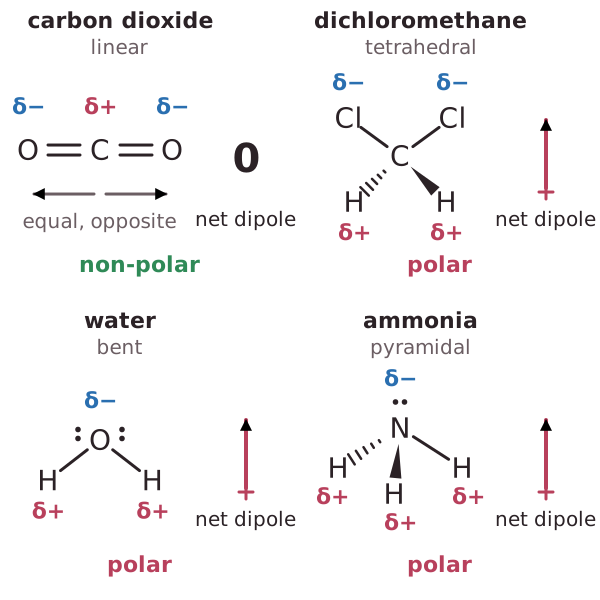
Polar bonds are formed between atoms with different electronegativities. For example, hydrogen chloride gas is polar. There is a small partial positive charge δ+ on the hydrogen and a small partial negative charge δ- on the chlorine atom.The H-Cl bond is polarised. The separation of opposite charges is called a dipole.Water is a polar molecule with the hydrogens being δ+ and the oxygens being δ-. Because the molecule is bent, the dipoles do not oppose each other.Carbon dioxide O=C=O has two polar C=O bonds. However, the molecule is linear and the dipoles oppose each other and cancel each other out, so carbon dioxide is non-polar.