Aluminium is in group 3 of the periodic table. For aluminium chloride AlCl3, the difference in electronegativity between aluminium and chlorine is not sufficient to form a simple ionic bond.
At room temperature, aluminium chloride forms an ionic lattice with a lot of covalent character.
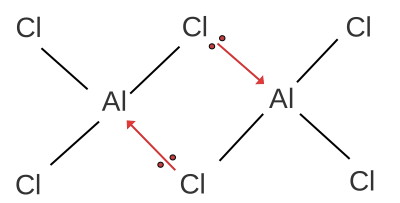
At 2atm or higher, aluminium chloride melts at 192°C. At lower pressures, it sublimes at about 180°C forming Al2Cl6 dimers by dative covalent (coordinate) bonding.
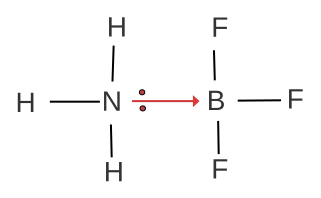
When ammonia (NH3) is added to boron trifluoride (BF3) a dative covalent bond (coordinate bond) forms between the nitrogen atom and the boron atom. The nitrogen atom donates its lone pair of electrons to the electron-deficient boron atom.
At room temperature, aluminium chloride forms an ionic lattice with a lot of covalent character.
At 2atm or higher, aluminium chloride melts at 192°C. At lower pressures, it sublimes at about 180°C forming Al2Cl6 dimers by dative covalent (coordinate) bonding.
When ammonia (NH3) is added to boron trifluoride (BF3) a dative covalent bond (coordinate bond) forms between the nitrogen atom and the boron atom. The nitrogen atom donates its lone pair of electrons to the electron-deficient boron atom.