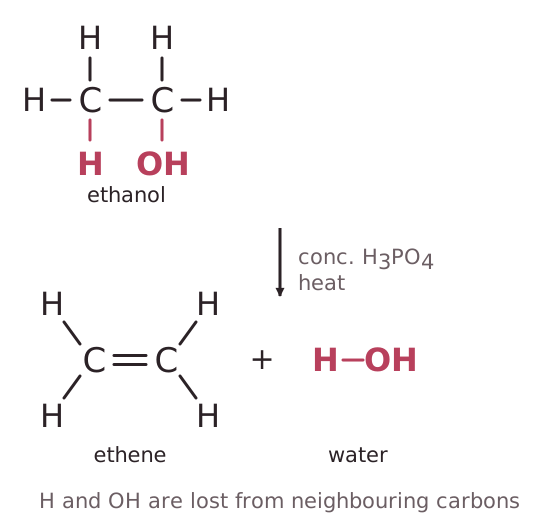
In an elimination reaction a small molecule, such as H2O or a hydrogen halide, is removed from a single larger molecule. A double bond forms where the atoms were removed.Removing water from an alcohol is called dehydration. The alcohol is heated with a concentrated acid catalyst such as phosphoric acid or sulfuric acid, for example C2H5OH → C2H4 + H2O.Halogenoalkanes can eliminate a hydrogen halide when heated with hydroxide ions in ethanol, forming an alkene.If the functional group is not at the end of the chain, elimination can give a mixture of alkene isomers, including E and Z isomers.