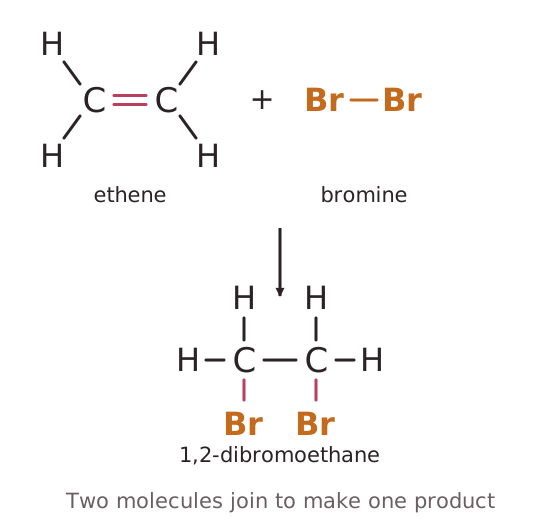
In an addition reaction two molecules join to form a single product. The π bond of a double bond breaks and an atom is added to each carbon atom.Alkenes undergo addition with hydrogen (nickel catalyst, about 150°C), halogens, hydrogen halides, and steam (phosphoric acid catalyst). For example, ethene and hydrogen form ethane.Because there is only one product, addition reactions have an atom economy of 100%.The addition of halogens and hydrogen halides to alkenes happens by electrophilic addition. Carbonyl compounds undergo nucleophilic addition across the C=O bond, for example with NaBH4.