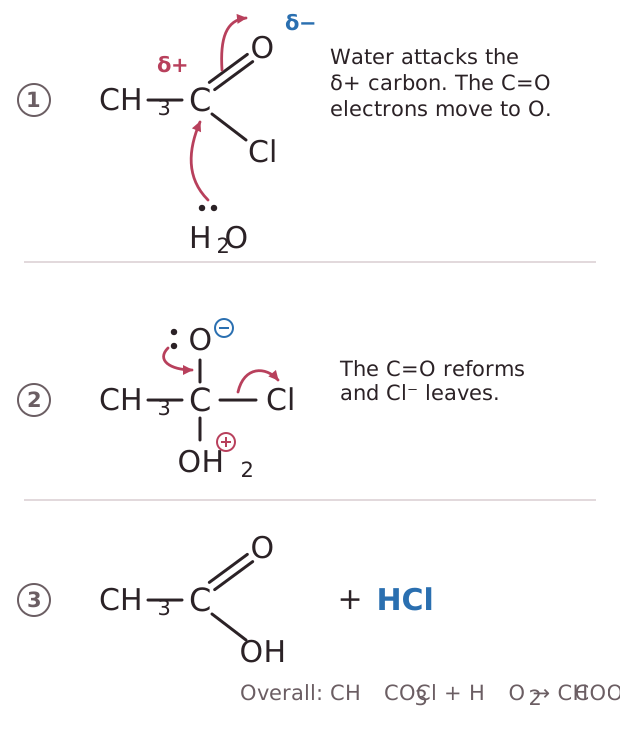
In an addition-elimination reaction a molecule first adds across a C=O double bond, then a small molecule is eliminated and the C=O bond reforms.Acyl chlorides react this way with water, alcohols, ammonia and amines. The nucleophile attacks the δ+ carbon of the C=O group, then a chloride ion is lost and HCl is formed.For example, ethanoyl chloride reacts with water: CH3COCl + H2O → CH3COOH + HCl. With ethanol it forms the ester ethyl ethanoate.The overall result is the same as a substitution, because the Cl atom is replaced by another group while the C=O group is kept.