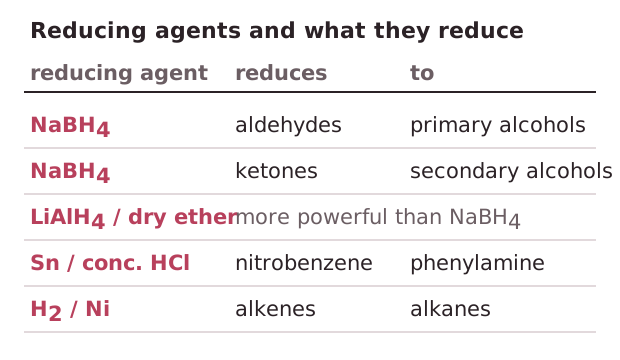
Reduction is the gain of electrons or a decrease in oxidation number. In organic chemistry it is usually seen as the addition of hydrogen or the removal of oxygen. A reducing agent brings about this change and is itself oxidised.In equations the reducing agent is often shown simply as [H], representing a hydrogen atom supplied by the reagent.Sodium tetrahydridoborate, NaBH4, supplies hydride ions H-. It reduces aldehydes to primary alcohols and ketones to secondary alcohols. Lithium tetrahydridoaluminate, LiAlH4, in dry ether is a more powerful reducing agent.Tin and concentrated hydrochloric acid reduce nitrobenzene to phenylamine. Hydrogen gas with a nickel catalyst reduces alkenes to alkanes.