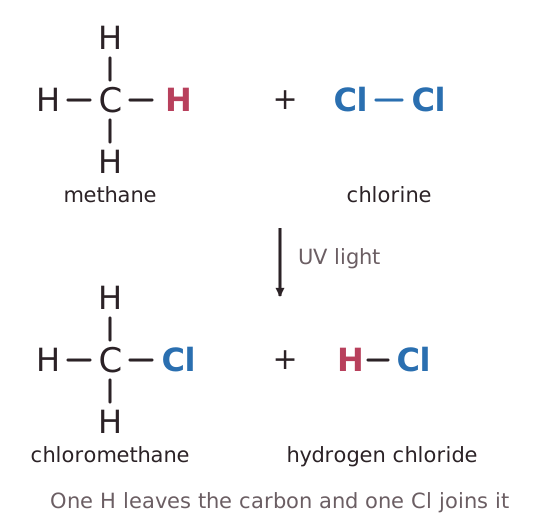
In a substitution reaction an atom or group of atoms in a molecule is replaced by a different atom or group.In free radical substitution, alkanes react with chlorine or bromine in ultraviolet light and a hydrogen atom is replaced by a halogen atom, for example CH4 + Cl2 → CH3Cl + HCl.In nucleophilic substitution, the halogen in a halogenoalkane is replaced by a nucleophile such as OH-. The C-I bond is weakest, so iodoalkanes are substituted fastest.In electrophilic substitution, a hydrogen atom on a benzene ring is replaced by an electrophile, for example in the nitration of benzene. The ring keeps its delocalised electrons.