In phenol, C6H5OH, an -OH group is bonded directly to the benzene ring. (It is not classed as an alcohol, because the -OH is on an aromatic carbon.)Phenol undergoes electrophilic substitution much more readily than benzene. The reason is the oxygen atom:
• A lone pair of electrons in a p-orbital on the oxygen overlaps with the π-system of the ring.
• The lone pair is partially delocalised into the ring.
• This increases the electron density of the ring.
• The electron-rich ring attracts electrophiles more strongly and can polarise molecules such as Br2, so no halogen carrier is needed.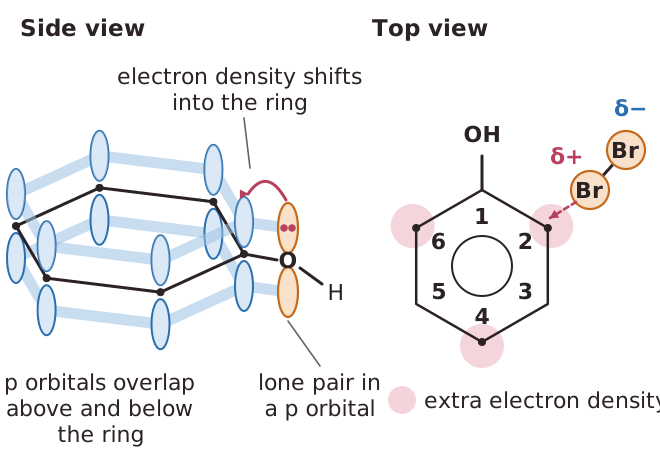 Comparing conditions
• Bromination: benzene needs Br2 with a halogen carrier; phenol reacts with bromine water at room temperature.
• Nitration: benzene needs concentrated nitric acid and concentrated sulfuric acid at about 50 °C; phenol reacts with dilute nitric acid at room temperature.Phenol also tends to be substituted more than once. With bromine water all three available 2-, 4- and 6- positions are substituted, while benzene with Br2/FeBr3 gives mainly monosubstitution.Example: a student adds bromine water to benzene and to phenol at room temperature. Benzene does not react (it stays orange, apart from bromine dissolving in the organic layer), while phenol decolourises the bromine water at once. The difference is explained by the delocalised oxygen lone pair raising the electron density of the phenol ring.
• A lone pair of electrons in a p-orbital on the oxygen overlaps with the π-system of the ring.
• The lone pair is partially delocalised into the ring.
• This increases the electron density of the ring.
• The electron-rich ring attracts electrophiles more strongly and can polarise molecules such as Br2, so no halogen carrier is needed.
Comparing conditions• Bromination: benzene needs Br2 with a halogen carrier; phenol reacts with bromine water at room temperature.
• Nitration: benzene needs concentrated nitric acid and concentrated sulfuric acid at about 50 °C; phenol reacts with dilute nitric acid at room temperature.Phenol also tends to be substituted more than once. With bromine water all three available 2-, 4- and 6- positions are substituted, while benzene with Br2/FeBr3 gives mainly monosubstitution.Example: a student adds bromine water to benzene and to phenol at room temperature. Benzene does not react (it stays orange, apart from bromine dissolving in the organic layer), while phenol decolourises the bromine water at once. The difference is explained by the delocalised oxygen lone pair raising the electron density of the phenol ring.