Friedel-Crafts reactions form a new carbon-carbon bond to a benzene ring. This is important in synthesis because it attaches a carbon chain to an aromatic ring, which most other reactions of benzene cannot do.In Friedel-Crafts alkylation, benzene reacts with a haloalkane in the presence of a halogen carrier such as AlCl3, forming an alkylbenzene. Conditions must be anhydrous, because water reacts with aluminium chloride and destroys the catalyst.Mechanism (electrophilic substitution)
1. The halogen carrier generates the electrophile, a carbocation:
CH3CH2Cl + AlCl3 → CH3CH2+ + AlCl4− 2. The delocalised electrons of benzene attack the carbocation, forming a positively charged intermediate.
3. The intermediate loses H+, restoring the stable delocalised ring.
4. The catalyst is regenerated: H+ + AlCl4− → AlCl3 + HCl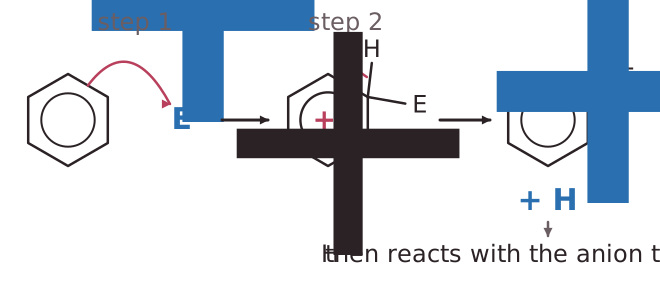 Overall:
C6H6 + CH3CH2Cl → C6H5CH2CH3 + HCl The product is ethylbenzene. With chloromethane the product would be methylbenzene.The alkylbenzene formed is more reactive than benzene, so it can be alkylated again, and a mixture of products may form.Worked example: what mass of ethylbenzene can be made from 7.80 g of benzene?
n(benzene) = 7.80 ÷ 78.0 = 0.100 mol. The ratio is 1 : 1, so at most 0.100 mol of ethylbenzene, C8H10 (Mr 106), forms.mass = 0.100 × 106 = 10.6 g
1. The halogen carrier generates the electrophile, a carbocation:
3. The intermediate loses H+, restoring the stable delocalised ring.
4. The catalyst is regenerated: H+ + AlCl4− → AlCl3 + HCl
Overall:n(benzene) = 7.80 ÷ 78.0 = 0.100 mol. The ratio is 1 : 1, so at most 0.100 mol of ethylbenzene, C8H10 (Mr 106), forms.