When a benzene ring that already has one substituent undergoes electrophilic substitution, the existing group affects where the new group goes. This is called a directing effect.The ring carbons are numbered from the carbon carrying the first substituent, which is carbon 1. Positions 2 and 6 are next to it, positions 3 and 5 are one further away, and position 4 is opposite. In a monosubstituted benzene, 2 and 6 are equivalent, as are 3 and 5.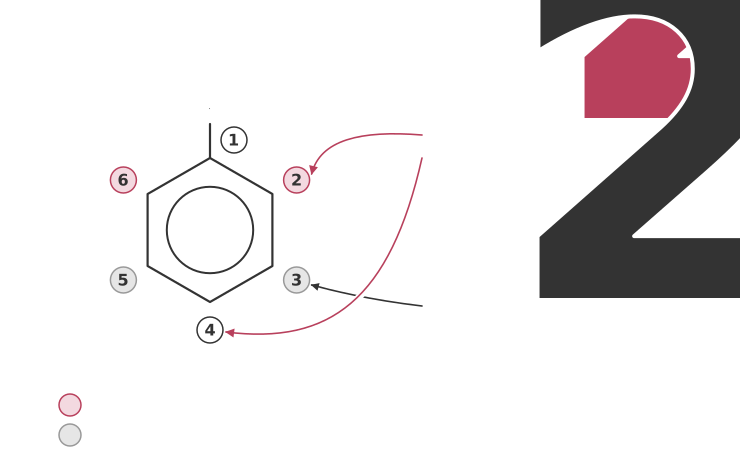
• Electron-donating groups, such as -OH and -NH2, are 2- and 4-directing. They also activate the ring, so it reacts faster than benzene.
• Electron-withdrawing groups, such as -NO2, are 3-directing. They deactivate the ring, so it reacts more slowly than benzene.Using directing effects
Directing effects let you predict the products of a substitution, and they decide the order of steps in a synthesis: the group that is put on first controls where the next one goes.Examples
• Phenol (-OH, 2,4-directing) with bromine water gives 2,4,6-tribromophenol.
• Nitrobenzene (-NO2, 3-directing) with Br2 and FeBr3 gives 1-bromo-3-nitrobenzene.When naming the product, give the substituents the lowest possible numbers and list them in alphabetical order, as in 1-bromo-3-nitrobenzene.