In Friedel-Crafts acylation, benzene reacts with an acyl chloride in the presence of a halogen carrier such as AlCl3, under anhydrous conditions. The product is an aromatic ketone, and a new carbon-carbon bond forms to the ring.Mechanism (electrophilic substitution)
1. The halogen carrier generates the electrophile, an acylium ion:
CH3COCl + AlCl3 → CH3CO+ + AlCl4− 2. The delocalised electrons of benzene attack the acylium ion, forming a positively charged intermediate.
3. The intermediate loses H+, restoring the delocalised ring.
4. The catalyst is regenerated: H+ + AlCl4− → AlCl3 + HCl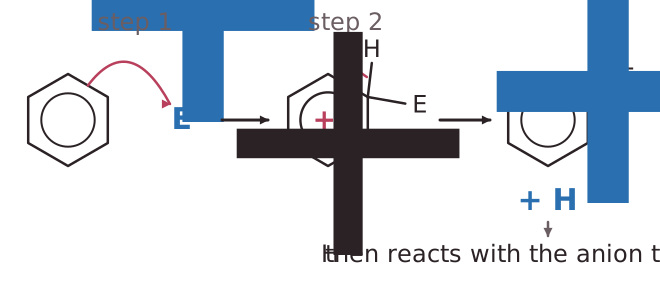 Overall, with ethanoyl chloride:
C6H6 + CH3COCl → C6H5COCH3 + HCl The product is phenylethanone.Acylation has an advantage over alkylation. The C=O group withdraws electron density from the ring, making the product less reactive than benzene, so a second acyl group is not added and a single product forms. The ketone can then be converted into other compounds; for example, NaBH4 reduces it to a secondary alcohol.Worked example: 7.80 g of benzene (0.100 mol) gives 9.00 g of phenylethanone, C8H8O (Mr 120).
n(phenylethanone) = 9.00 ÷ 120 = 0.0750 molpercentage yield = 0.0750 ÷ 0.100 × 100 = 75%
1. The halogen carrier generates the electrophile, an acylium ion:
3. The intermediate loses H+, restoring the delocalised ring.
4. The catalyst is regenerated: H+ + AlCl4− → AlCl3 + HCl
Overall, with ethanoyl chloride:n(phenylethanone) = 9.00 ÷ 120 = 0.0750 mol