Phenol reacts with bromine water at room temperature, without a halogen carrier. This is an electrophilic substitution.Observations
• The orange bromine water is decolourised.
• A white precipitate of 2,4,6-tribromophenol forms.EquationC6H5OH + 3Br2 → C6H2Br3OH + 3HBr Three hydrogen atoms on the ring are replaced by bromine atoms, at positions 2, 4 and 6 (numbering the carbon with the -OH group as 1). Each substitution uses one Br2 and forms one HBr, so three moles of bromine react with each mole of phenol.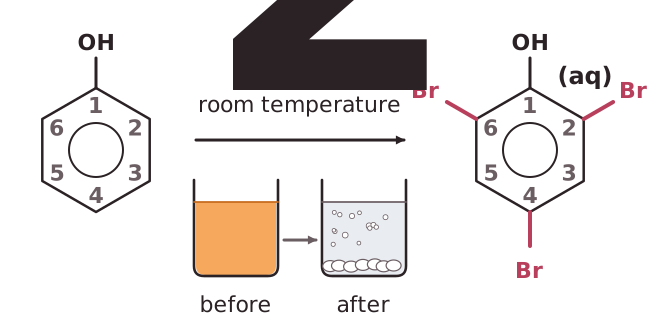 Why no halogen carrier is needed
A lone pair from the oxygen is partially delocalised into the ring, increasing its electron density. The electron-rich ring polarises the Br2 molecule, inducing a dipole, so the δ+ bromine atom acts as the electrophile. Benzene's ring has too low an electron density to do this, so benzene needs a halogen carrier and gives only monosubstitution.The formation of a white precipitate with bromine water can be used to show that a compound contains a phenol group.Worked example: what mass of 2,4,6-tribromophenol (Mr 330.7) forms from 0.940 g of phenol (Mr 94.0), assuming complete reaction?
n(phenol) = 0.940 ÷ 94.0 = 0.0100 mol, so 0.0100 mol of product forms.mass = 0.0100 × 330.7 = 3.31 g This needs 3 × 0.0100 = 0.0300 mol of Br2.
• The orange bromine water is decolourised.
• A white precipitate of 2,4,6-tribromophenol forms.Equation
Why no halogen carrier is neededA lone pair from the oxygen is partially delocalised into the ring, increasing its electron density. The electron-rich ring polarises the Br2 molecule, inducing a dipole, so the δ+ bromine atom acts as the electrophile. Benzene's ring has too low an electron density to do this, so benzene needs a halogen carrier and gives only monosubstitution.The formation of a white precipitate with bromine water can be used to show that a compound contains a phenol group.Worked example: what mass of 2,4,6-tribromophenol (Mr 330.7) forms from 0.940 g of phenol (Mr 94.0), assuming complete reaction?
n(phenol) = 0.940 ÷ 94.0 = 0.0100 mol, so 0.0100 mol of product forms.