 BRAINCAKE
Titration Curves
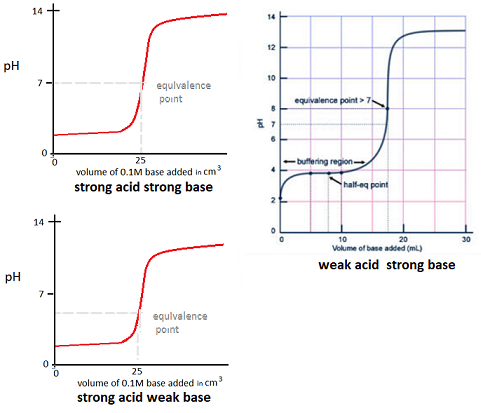
In a titration, you measure the volume of the solution in the burette that is needed to react exactly with the solution in the conical flask. This is known a the equivalence point. Acid-base titration can be carried out and the pH can be plotted as the reaction progresses. The pH can be measured using a pH meter and data logger connected to a computer. Considering an acid-base titration with an alkali such as sodium hydroxide added to a strong acid such as hydrochloric acid. When the base is first added, the pH increases only slightly because the acid is in excess. This is because the conjugate base is being made and it is creating a buffer solution which is resisting the change in the pH. Within 1-2 cm3 of the equivalence point, the pH starts to increase rapidly. There is only a small amount of acid left, so with the addition of a tiny amount of alkali, the solution is neutralised and there is a very sharp increase in pH.
Sign in free to see the rest of this lesson, the R.E.C.I.P.E. recall steps and the quiz
BrainCake is free. Make an account in seconds and pick up where this page stops.
Key terms in this lesson
- buffer solution
- A solution that resists changes in pH when small amounts of acid or alkali are added.
More in Acids, Bases and Buffers
- Calculating the pH of a Weak Acid
- The Ionic Product of Water Kw
- Calculating the pH of a Strong Base
- Buffer Solutions
- pH of a Buffer Solution
- Controlling the pH of Blood
- Acid-Base Indicators
- Standard Enthalpy of Neutralisation
All 15 lessons in Acids, Bases and Buffers · All OCR A-level Chemistry topics