Pure water ionises into H+(aq) and OH-(aq) ions to a very tiny extent.H2O(l) ⇌ H+(aq) + OH-(aq)The equilibrium lies to the far left and there are very few ions. The dissociation is endothermic and requires energy. The expression for the acid dissociation constant is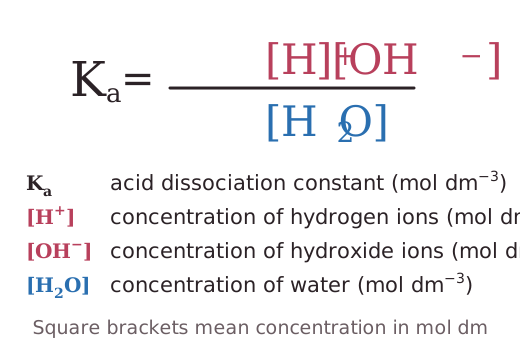 Since both [H2O(l)] and Ka are constant, this can be combined into one constant called Kw.Kw = [OH-][H+]At 25°C Kw = 1.0 x 10⁻¹⁴ mol2dm-6. This is the neutral point where [H+] = [OH-] for pure water so the [H+] at 25°C is 1.0 x 10⁻⁷
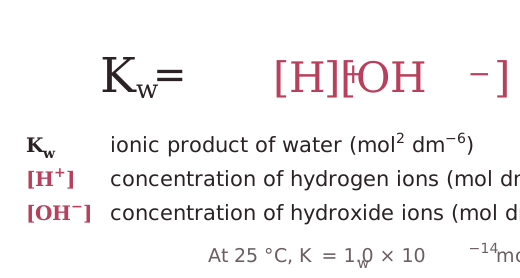
Since both [H2O(l)] and Ka are constant, this can be combined into one constant called Kw.Kw = [OH-][H+]At 25°C Kw = 1.0 x 10⁻¹⁴ mol2dm-6. This is the neutral point where [H+] = [OH-] for pure water so the [H+] at 25°C is 1.0 x 10⁻⁷