 BRAINCAKE
pH of a Buffer Solution
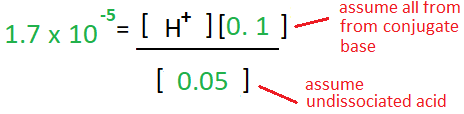
To find the pH of any solution, you need to determine the hydrogen ions concentration. Most of the acid is undissociated for the HA can be assumed to be the original (undissociated) acid concentration. Most of the anion comes from the conjugate base which dissociates completely. Very little is from the undissociated acid. So the anion concentration is assumed to be the original conjugate base concentration.
Sign in free to see the rest of this lesson, the R.E.C.I.P.E. recall steps and the quiz
BrainCake is free. Make an account in seconds and pick up where this page stops.
Key terms in this lesson
- buffer solution
- A solution that resists changes in pH when small amounts of acid or alkali are added.
- conjugate base
- The species left after an acid has donated a proton.
- acid dissociation constant Ka
- The equilibrium constant for the dissociation of a weak acid in aqueous solution.
- pH
- A measure of the hydrogen ion concentration of a solution, defined as pH = -log10[H+].
More in Acids, Bases and Buffers
- Calculating the pH of a Weak Acid
- The Ionic Product of Water Kw
- Calculating the pH of a Strong Base
- Buffer Solutions
- Controlling the pH of Blood
- Titration Curves
- Acid-Base Indicators
- Standard Enthalpy of Neutralisation
All 15 lessons in Acids, Bases and Buffers · All OCR A-level Chemistry topics