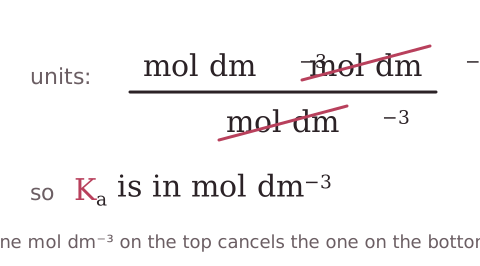
A weak acid only partially dissociates in aqueous solution, setting up an equilibrium:HA(aq) ⇌ H+(aq) + A-(aq)The equilibrium constant for this dissociation is called the acid dissociation constant, Ka. Its expression is: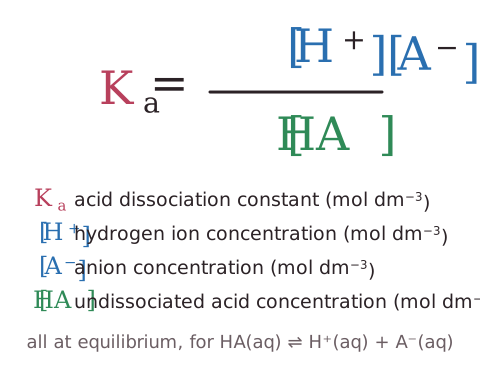 The units can be found by substituting units for the concentrations, which gives mol dm-3:
 Ka measures the strength of a weak acid. The larger the value of Ka, the greater the extent of dissociation and the stronger the acid. For example, methanoic acid (Ka = 1.6 × 10⁻⁴ mol dm-3) is a stronger acid than ethanoic acid (Ka = 1.7 × 10⁻⁵ mol dm-3). Like all equilibrium constants, Ka changes only with temperature.
The units can be found by substituting units for the concentrations, which gives mol dm-3:Ka measures the strength of a weak acid. The larger the value of Ka, the greater the extent of dissociation and the stronger the acid. For example, methanoic acid (Ka = 1.6 × 10⁻⁴ mol dm-3) is a stronger acid than ethanoic acid (Ka = 1.7 × 10⁻⁵ mol dm-3). Like all equilibrium constants, Ka changes only with temperature.