The accepted model of benzene is the delocalised model.Each carbon atom has four outer electrons. It uses three of them to form σ bonds: one to each neighbouring carbon and one to a hydrogen. These three bonds lie in the same plane at 120° to each other, which makes the molecule a flat, regular hexagon.The fourth electron on each carbon is in a p orbital, which sticks out above and below the plane of the ring. Each p orbital overlaps sideways with the p orbitals on both of its neighbours. The result is a continuous ring of electron density above and below the plane of the ring, containing all six delocalised electrons. These electrons are not attached to any one carbon atom or bond; they are shared by all six carbons.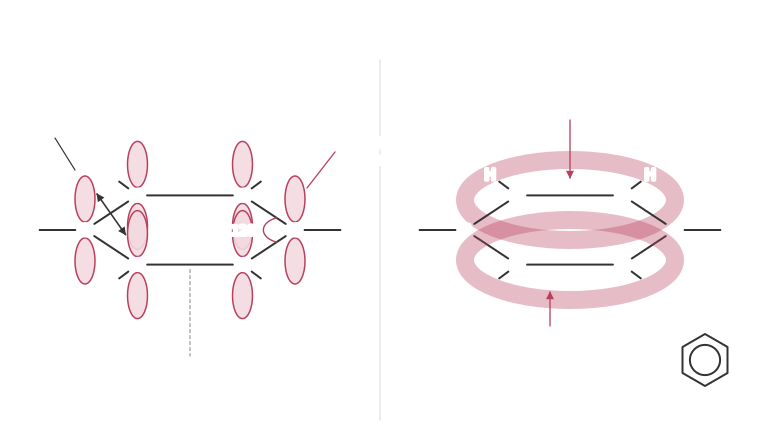
• Every C-C bond has the same share of the delocalised electrons, so all bonds have the same length (0.139 nm), between single and double.
• Delocalisation spreads the electron density out, which lowers the energy and makes benzene extra stable.
• Addition would break up the delocalised system and lose this stability, so benzene prefers substitution reactions, which keep the ring intact.In skeletal formulae, the delocalised system is shown as a circle inside the hexagon. Each corner is a carbon atom with one hydrogen, which is not drawn.