Benzene, C6H6, is the simplest arene. Compounds that contain a benzene ring are called arenes or aromatic compounds; the name comes from the strong smells of many early examples. Its empirical formula is CH.Benzene is a colourless liquid at room temperature (boiling point 80 °C). It is toxic and a known carcinogen, so in school laboratories it is usually replaced by safer arenes such as methylbenzene.Shape. The six carbon atoms form a planar, regular hexagon, with one hydrogen on each carbon. Every bond angle (C-C-C and H-C-C) is 120°, and all six carbon-carbon bonds are the same length, 0.139 nm. This is between the length of a C-C single bond (0.154 nm) and a C=C double bond (0.134 nm).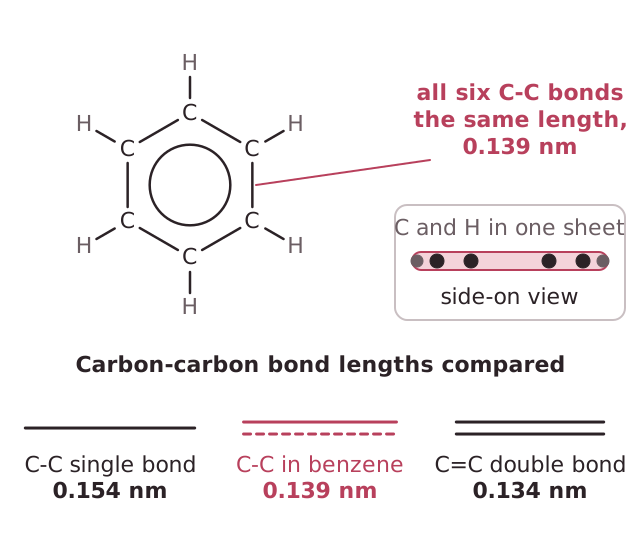 Stability. Benzene is much more stable than its formula suggests. With six carbons and only six hydrogens you might expect it to behave like an alkene, but it does not decolourise bromine water at room temperature and it resists addition reactions. Instead it usually reacts by electrophilic substitution, in which a hydrogen atom is replaced and the stable ring is kept.Benzene is drawn as a hexagon with a circle inside. The next lessons explain why: first the historical Kekulé model, then the delocalised model, and the enthalpy evidence that decides between them.