The nitration of benzene follows the electrophilic substitution mechanism. You need to be able to write every step.Forming the electrophile. Concentrated sulfuric acid reacts with concentrated nitric acid to make the nitronium ion, NO2+:HNO3 + H2SO4 → NO2+ + HSO4− + H2O 
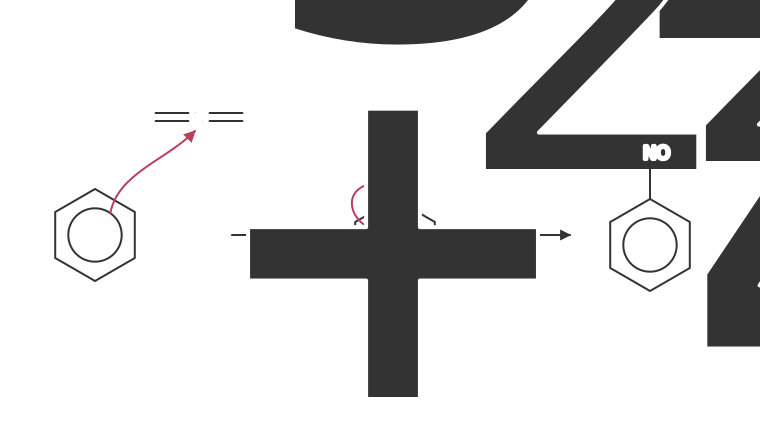
Step 1. A curly arrow is drawn from the delocalised ring to the nitrogen atom of NO2+: a pair of delocalised electrons forms a new C-N bond. The carbon that bonds to N now holds both H and NO2 and is no longer part of the delocalised system. The intermediate is drawn as a horseshoe covering the other five carbon atoms, with a positive charge inside it. The horseshoe must open towards the carbon bonded to H and NO2.Step 2. A curly arrow goes from the C-H bond back into the ring. The electrons restore the full delocalised ring and a proton (H+) is lost, giving nitrobenzene.Regenerating the catalyst. The H+ released reacts with the hydrogensulfate ion:H+ + HSO4− → H2SO4 so the sulfuric acid is regenerated and acts as a catalyst.Common mistakes: starting the first arrow from a single carbon instead of the ring, pointing it at an oxygen of NO2+, and drawing the horseshoe too big or with no + charge.
Mechanism of Nitration
Read the text
Read the text and highlight anything you think is important. When you go on, the text is hidden and you answer from memory.
Specification: AQA Chemistry (7405), A-level, 3.3.10.2 Electrophilic substitution. Topic: Aromatic Chemistry.
More in Aromatic Chemistry
- The Delocalised Model of Benzene
- Evidence for Delocalisation - Enthalpy of Hydrogenation
- Naming Aromatic Compounds
- Electrophilic Substitution
- Nitration of Benzene
- Uses of Nitration
- Friedel-Crafts Acylation
- Mechanism of Friedel-Crafts Acylation
All 11 lessons in Aromatic Chemistry · All AQA A-level Chemistry topics