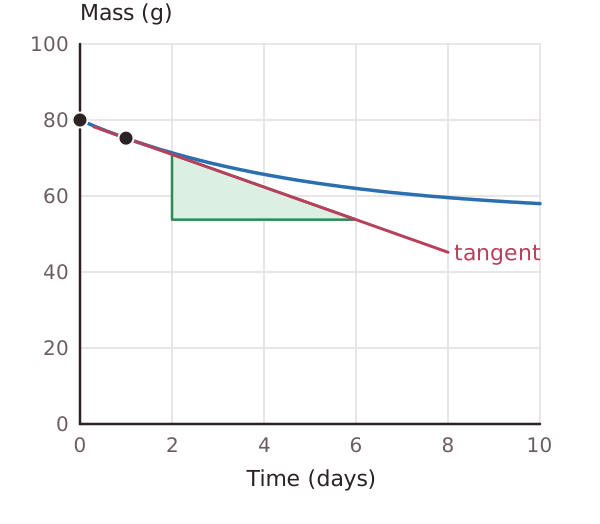
Decay is the breakdown of dead plant and animal material by microorganisms. As the material is broken down, it loses mass, so we can measure how fast decay is happening by weighing a sample at regular intervals. The rate of decay is the change in mass divided by the time taken: rate = change in mass ÷ time. If the units are grams and days, the rate is in g per day.
Example: a sample of leaf litter falls from 80 g to 62 g in 6 days. The mass lost is 18 g. The rate is 18 ÷ 6 = 3 g per day. The percentage loss of mass compares the loss with the original mass: 18 ÷ 80 × 100 = 22.5%. Always divide by the original mass, not the final mass.
The rate does not have to stay the same. Suppose a compost heap loses 10 g in the first 5 days, then 5 g in the next 5 days. The rate is 2 g per day at first, then 1 g per day. The rate of decay has decreased, perhaps because the food supply for the microorganisms is running low or the material has dried out.
On a graph of mass against time, a falling line shows decay. The rate at any moment is the gradient of the line. For a curve, draw a tangent to the curve at that point and find its gradient. A steeper line means a faster rate of decay, and a line that levels off means decay has slowed or stopped.