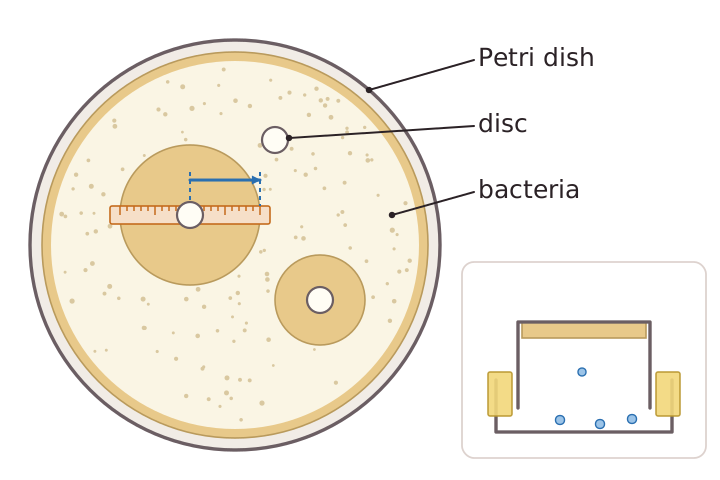
Bacteria multiply by simple cell division, called binary fission. If they have enough nutrients and a suitable temperature, they can divide as often as once every 20 minutes. Bacteria can be grown in a nutrient broth solution, or as colonies on an agar gel plate. Investigating disinfectants and antibiotics needs an uncontaminated culture.
To prepare an uncontaminated culture you use aseptic technique. Petri dishes and culture media are sterilised first, to kill unwanted microorganisms. The inoculating loop that transfers the bacteria is passed through a flame, which kills any unwanted microorganisms on it. The lid of the dish is secured with adhesive tape so that microorganisms from the air cannot get in, and the dish is stored upside down so that drops of condensation fall onto the lid and not onto the agar. In school laboratories cultures are generally incubated at 25 °C. A higher temperature, close to body temperature at 37 °C, would encourage the growth of pathogens that could harm people.
Counting: if the mean division time is 20 minutes, one bacterium becomes 2 after 20 minutes, 4 after 40 minutes and 8 after 60 minutes. Two hours is 6 divisions, so 2 × 2 × 2 × 2 × 2 × 2 = 64 bacteria. The numbers after each division run 2, 4, 8, 16, 32, 64. Higher tier students also give large answers in standard form, for example 1 048 576 = 1.048576 × 10⁶.
Required practical: to test antiseptics or antibiotics, spread bacteria over an agar plate and place discs soaked in each substance on it. Where a substance kills bacteria, a clear area called a zone of inhibition forms around its disc. The largest clear zone shows the most effective substance. The cross-sectional area of a zone is πr2, where r is the radius, which is half the diameter. For example, a zone with a diameter of 20 mm has a radius of 10 mm and an area of about 314 mm2.