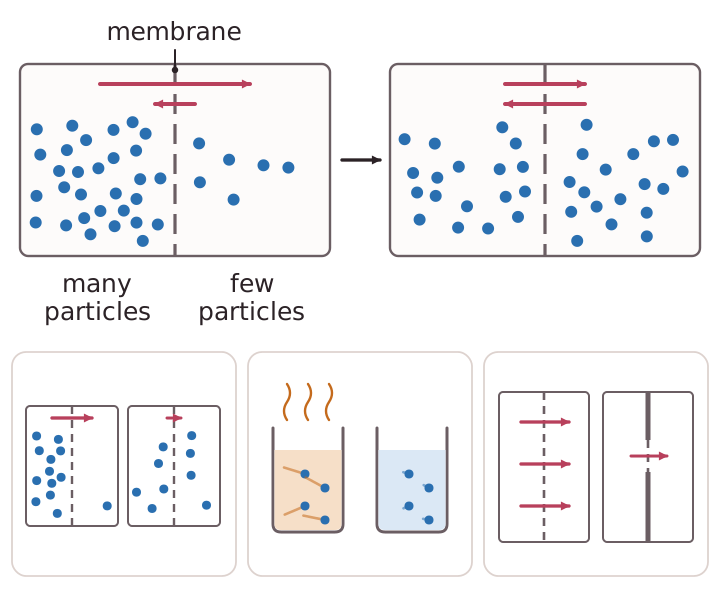
Diffusion is the spreading out of the particles of a gas, or of particles in a solution, from an area of higher concentration to an area of lower concentration. The overall movement of particles is called the net movement, and it goes down the concentration gradient. Cells use diffusion to move oxygen and carbon dioxide in gas exchange, and to move the waste product urea from cells into the blood plasma, where it is carried to the kidney for excretion.
Three factors change the rate of diffusion. A bigger difference in concentration (a steeper concentration gradient) makes diffusion faster. A higher temperature makes diffusion faster, because the particles move more quickly. A larger surface area of membrane makes diffusion faster, because more particles can cross at once.
A single-celled organism has a large surface area to volume ratio, so enough molecules can diffuse in and out to meet its needs. A multicellular organism has a much smaller surface area to volume ratio, so it needs specialised exchange surfaces and a transport system. For a cube with sides of 2 cm, the surface area is 6 × 2 × 2 = 24 cm2, the volume is 2 × 2 × 2 = 8 cm3, and the ratio is 24 : 8, which is 3 : 1.
An effective exchange surface has a large surface area and a thin membrane, which gives a short diffusion path. In animals it also has an efficient blood supply, and for gas exchange it is ventilated. The small intestine, lungs, gills in fish, and the roots and leaves of plants are all adapted in these ways.