Active Transport is the movement of molecules or ions into or out of a cell from a region of lower concentration to a region of higher concentration using ATP and carrier proteins.Active transport differs from passive transport because it uses metabolic energy in the form of ATP and uses carrier proteins to selectively move ions and molecules against their concentration gradient.The mechanism of active transport is as follows: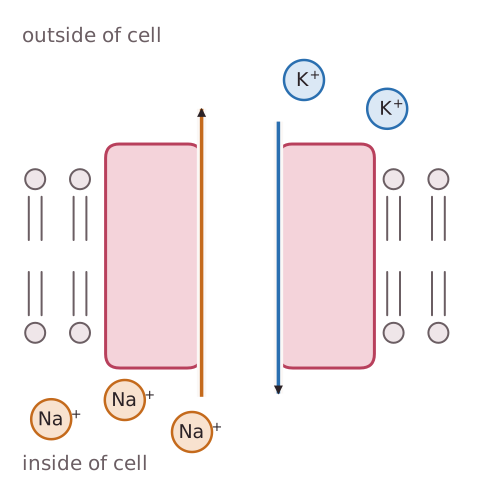
- The molecule to be transported binds to the carrier protein on one side of the membrane.
- ATP binds to another receptor site on the same side of the membrane. ATP is hydrolysed to ADP and inorganic phosphate as a result.
- ADP is released and the carrier protein changes shape releasing the molecule on the other side.
- The phosphate molecule is released. This causes the carrier protein to revert back to its original shape.