Like simple diffusion, facilitated diffusion is a passive process.It relies on diffusion through a protein channel or carrier protein.Small molecules which cannot diffuse through the plasma membrane because of the hydrophobic fatty acid tails of the phospholipid forming an impenetrable barrier to polar or charged particles such as charged ions and polar molecules, must pass through transmembrane proteins that span the membrane.The molecules either pass through protein channels or use carrier proteins to go across the membrane.
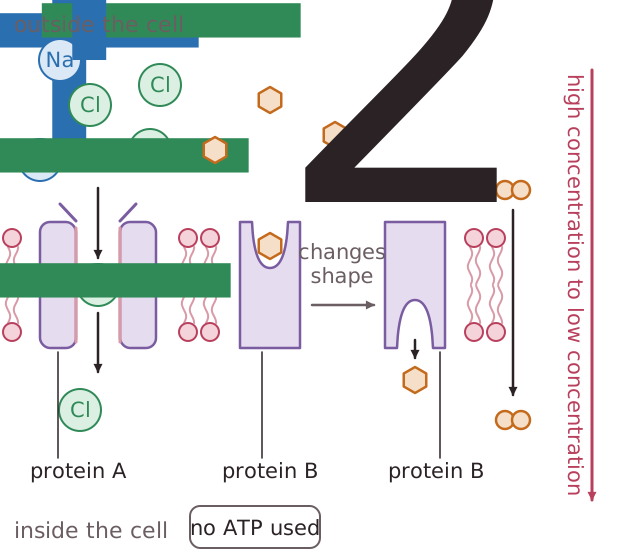
Facilitated Diffusion
Read the text
Read the text and highlight anything you think is important. When you go on, the text is hidden and you answer from memory.
Specification: OCR Biology A (H020), AS-level, 2.1.5 Biological membranes. Topic: Plasma Membrane.
Key terms in this lesson
- ATP
- Adenosine triphosphate, a nucleotide that acts as the immediate energy source of a cell, releasing energy when hydrolysed to ADP and inorganic phosphate.
- diffusion
- The net movement of molecules or ions from a region of higher concentration to a region of lower concentration, down a concentration gradient.
- active transport
- The movement of molecules or ions across a membrane, often against their concentration gradient, using ATP and carrier proteins.
More in Plasma Membrane
- Effect of Temperature
- Solvents
- Diffusion
- Diffusion Across Membranes
- Active Transport
- Bulk Transport
- Osmosis
- Osmosis in Animal Cells
All 18 lessons in Plasma Membrane · All OCR AS-level Biology topics