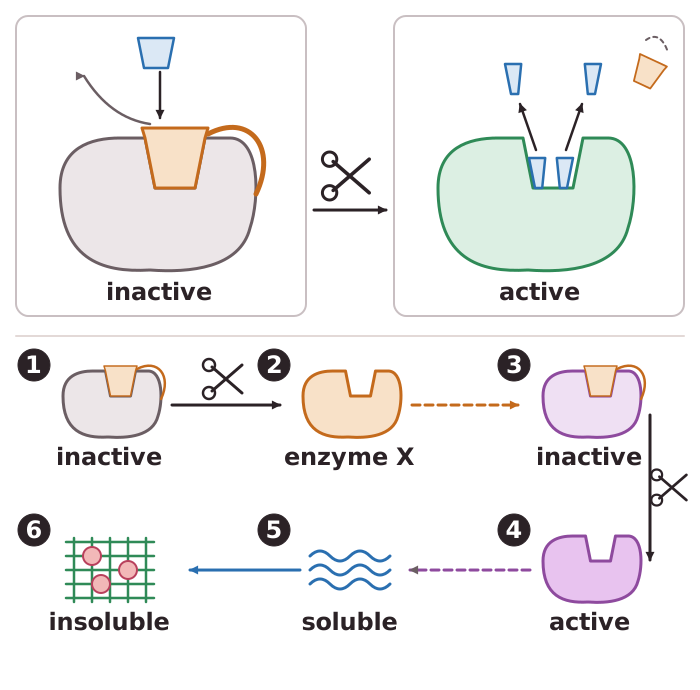
Many enzymes are produced as inactive precursors (called zymogens) so that they do not damage the cells producing them.The precursors undergo a change of tertiary structure, particularly of the active site, before they are able to function.Activation can be brought about by the addition of a cofactor or a protease may cleave the precursor enzyme to make it active.In other cases a change in conditions such as pH or temperature results in a change to the tertiary structure.Pepsin is produced as inactive pepsinogen and is secreted into the stomach. The low pH due to hydrochloric acid converts the pepsinogen to active pepsin.Blood clotting is a response to tissue damage.Platelets aggregate at the site of tissue damage and release clotting factors.Vitamin K dependent factor X catalyses the activation of prothrombin into the protease enzyme thrombin by cleaving the molecule which alters the tertiary structure.thrombin catalyses the conversion of soluble fibrinogen to insoluble fibrin.