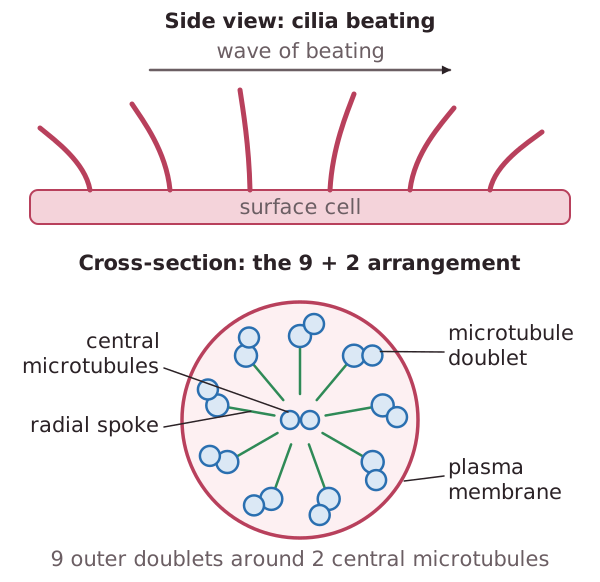
Cilia have both motility and sensory functions.They beat in a wave-like motion to move cells or to move the cytoplasm around in cells.In the female reproductive system cilia line the oviduct to move eggs and the embryo towards the uterus.They also line the respiratory tract to move mucus and particles trapped in the mucus out of the respiratory tract.In the eye, they have a sensory function, covering photo receptors to allow signals to move between cells and in the kidney they sense the movement of water.Cilia are usually numerous and shorter than flagella.Flagella are long bundles of microtubules that can propel cells or pull cells in one direction.In males, flagella propel sperm through the female body towards the egg.Both cilia and flagella are made of 9 pairs of microtubules arranged in a circular wheel around a central pair of microtubules in a 9+2 arrangement.